Category: CI5190

Follow my journey through my final master’s project at the University of Minnesota’s Learning Technologies Program. My project is based on my work at the National Youth Leadership Council where we are integrating digital badges and an interactive project planning tool into our online community, the Generator School Network (www.gsn.nylc.org). In a small but national non-profit, an employee must be a jack-of-all-trades: instructional designer, project manager, evaluator, and web designer. This project is an example of just that.

Without the new skills and knowledge that I gained through the University of Minnesota’s Learning Technologies program, none of this would be possible. Reminder that the first post starts at the bottom and that the opinions presented below represent my own, not my organization or my school.

  • Laying the Foundation

    Laying the Foundation

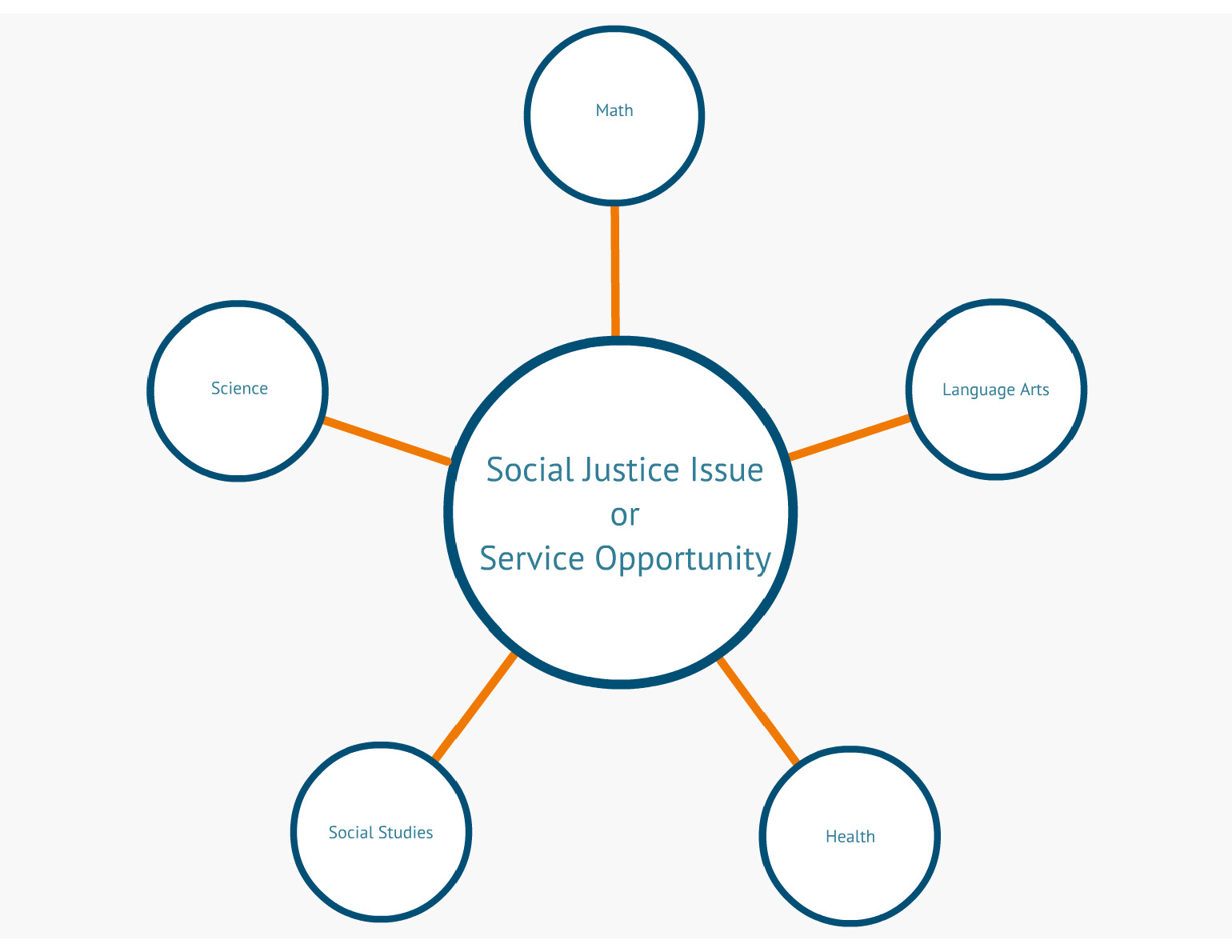
    Modules 1-3 represent the unit or project plan for the user(s). It will be in this section that they answer the questions:

    1. What will youth know or be able to do at the end of this project? (Identify Desired Results)
    2. How will you know they have learned that knowledge or gained those skills? (Determine Acceptable Evidence)
    3. And finally what activities or lessons will they participate in to achieve those results? (Plan Student Experiences)

    For each module NYLC will be capturing videos that show projects in that phase of planning and implementing. These videos could capture instruction, interviews with adults or students, or students serving in the community. While it will take time to build the video library to start off we want to capture a K-12 classroom educator at each level (elementary, middle, and high school), a group student (who serve in a youth council of some sort), and an educator that works outside of the formal K-12 classroom in each step of the planning and implementing process. Luckily, we have a budget to make this happen.

    Each project that is featured through video will have the formal curriculum to support ensuring that members can cross reference the larger plan when watching shorter videos. Additional videos could also include mini (3-5) webinars or instructional videos created by NYLC. Each module is set up so that the videos and supporting documents can be modified at anytime because we know that videos age quickly and we want the tool to stay relative and build over time.

    Another constant through the modules will be the presence and encouragement of using the K-12 Service-Learning Standards for Quality Practice. While the modules represent the different steps in the recipe, the K-12 Service-Learning Standards for Quality Practice represent the ingredients. Majority of NYLC’s resources are based on these standards and many of these standards happen naturally within service-learning. However, there are key indicators for using the standards with quality.

    Every module will feature supporting resources to guide users through answering the questions. For instance in module one there will be documents that users can call upon to look up the Common Core State Standards, the Next Generation Science Standards, civic outcomes, character outcomes, and leadership outcomes if they need help defining their desired outcomes. Along with the library of standards, their will be resources to help decide guiding questions as well as unpacking those standards and goals.

    Module two will have supporting resources that support users in defining how youth will prove their growth for the defined outcomes in module one. Again with videos but also with content that teaches how to create a rubric, what are examples of formative and summative assessments, how can young people self or peer assess? Often times the assessment or final project in service learning is the service itself or the demonstration of that service. This can be very tricky because one of the standards for service-learning is youth voice so how can educators ensure that students are meeting the standards but still getting voice and choice.

    Module three will use the IPARD model for service-learning to plan the student experience. Often times people start with this step when planning but this is really the student inquiry process for service-learning and doesn’t represent a full plan. For each step of the IPARD process we will have supporting resources:

    IPARD


    via gsn.nylc.org

    Investigation: community research, inquiry based lesson, defining the community need

    Planning: how the need will be met, student roles and collaborations, who in the community can you call upon for support

    Action: direct, indirect, or advocacy, addressing the root cause vs. putting a band aid on an issue

    Reflection: cognitively challenging reflection, happens before during and after, multiple intelligences

    Demonstration: reporting results to the community, proposing next steps, engaging important stakeholders

    Modules 1-3 will have a similar feel, after a member plans module 1-3 they will go back and add evidence as their plan comes to fruition.

  • Hard Hat Area

    Hard Hat Area

    Based on my research there is not a project-based learning tool or a service-learning online multimedia tool that guides educators or students through the process. There are a lot of worksheets and handouts but nothing interactive or engaging.

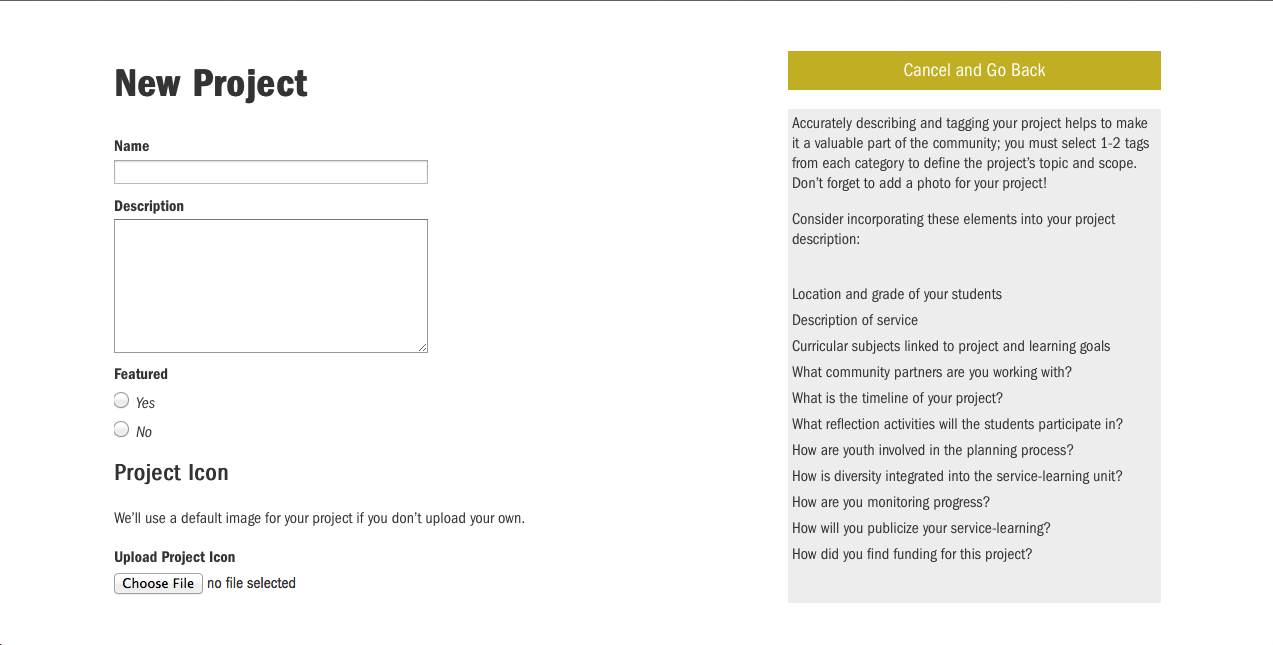
    Currently on our site a user titles their project, then adds a description, some “tags” to make it easier to search and then publishes. Leaving it up to them if they are interested in adding additional resources such as unit/project plans, supporting documents, pictures, or videos. Since there is no incentive for doing so, unless being directed by an instructional coach or program coordinator many projects are left unfinished. Which leaves us with a library of half-ideas for projects. We encourage and take pride that users upload their projects at the inception of the idea vs. when the project is complete but often that strategy backfires.

    Screen Shot 2014-05-08 at 6.04.09 PM Screen Shot 2014-05-08 at 6.04.29 PM

    Hopefully with the integration of the project-planning tool it will better guide members in sharing specific details and helpful pieces of evidence. By integrating the digital badges members will ideally feel incentivized to continue working on their project. Another feature that will support this is email reminders for those who have begun projects but then deserted them.

    In the simplest form, this is how the tool will work. Modules 1-3 will guide the user through a series of questions based on what NYLC believes are the best steps for planning. The questions will all be guided with resources to help the user(s) plan their projects.

    PPT 1

    Ideally, this happens at the beginning before the project happens but if not the users can retroactively share what happened. From there before moving onto module four the users will upload pieces of evidence which could be student samples, newsletters about the project, videos from class or media coverage, pictures of students working, etc.

    PPT

    The tool will require them to upload five artifacts or pieces of evidence before moving onto module four which is self-assessment. At this point the user’s project can be complete, or they can choose to enter their project into a queue to be peer-assessed. The peers will use the evidence and artifacts to rate and give feedback to their peer. Both the project creator and the assessor will receive a badge for participating. If the project creator wants to complete the full cycle, they can submit their project for NYLC adjudication. The only catch is that will be for a charge because it requires staff time. If the member is a part of a specific NYLC program they may be granted a code to bypass the fee.

    PPT 2

    Without getting too far into details about the specific modules some overall tool will include the following features:

    • Multiple members may co-create projects
    • The user(s) can print at any time
    • The user(s) will receive email notifications if:
    1. Their project has been sitting too long in steps 1-3 without updating or evidence added
    2. Their project has steps 1-3 completed and evidence added but hasn’t been self-assessed.
    3. Their project has been peer assessed
    4. Their project has been NYLC assessed
    • As soon as they move to the next module their project will be saved
    • Members can go back and forth between modules or just use the tool as a professional development opportunity

    Alternative uses

    Many service-learning organizations and funders offer small grants $500-$10,000 to schools and classes for service-learning projects. Many of the grants ask similar questions to our module 3. If educators and youth are already going through this process to share their project, why not make the grant application within the same tool? The GSN gets more content, the tool has multiple purposes, and the grant applicant gets support along the way. The grant module would feature any additional question that the funder or program would need addressed in order to be processed. This may be logistical questions, information about their specific issue area, or other questions. The module would be modified based on the grant application.

    From there, NYLC can pull the applications, judge them and award the best ones a grant and a badge.

    PPT B

  • Project-Planning Tool

    Project-Planning Tool

    While this semester, my growth and learning in terms of learning technologies has primarily been focused on digital badges, it really only represents half of the updates I am making to the online community. The second half is the creation of an interactive, multi-media, service-learning project planning tool. The need and idea for this tool came from several areas:

    Service-Learning often gets a bad wrap in the classroom because people are not planning or implementing with quality. Either their focus is too much on the service or it becomes project-based learning, both equally good things amongst themselves but they are not service-learning.

    We see educators and students starting with the genuine community need, planning activities, and loosely tying it back to goals and outcomes. These projects may have impact on students but often focus on the “nice-to-know” vs. the “need-to-know”. And with the continued focus on accountability schools do not have time for the “nice-to-know”.

    yourprezi_Page_04

    We also see educators and students using the K-12 Service-Learning Standards for Quality Practice as their planning tool. And while the standards do represent the best practices within service-learning, amongst themselves do not provide enough support to bring students from A-Z.

    yourprezi_Page_05

    A widely used model for planning service-learning is the IPARD model: Investigation, Planning, Action, Reflection, and Demonstration. It is similar to many inquiry models in education but this is the process the students go through and before we get to this process, educators should have their goals and outcomes defined and their assessments mapped.

    IPARD


    via nylc.org

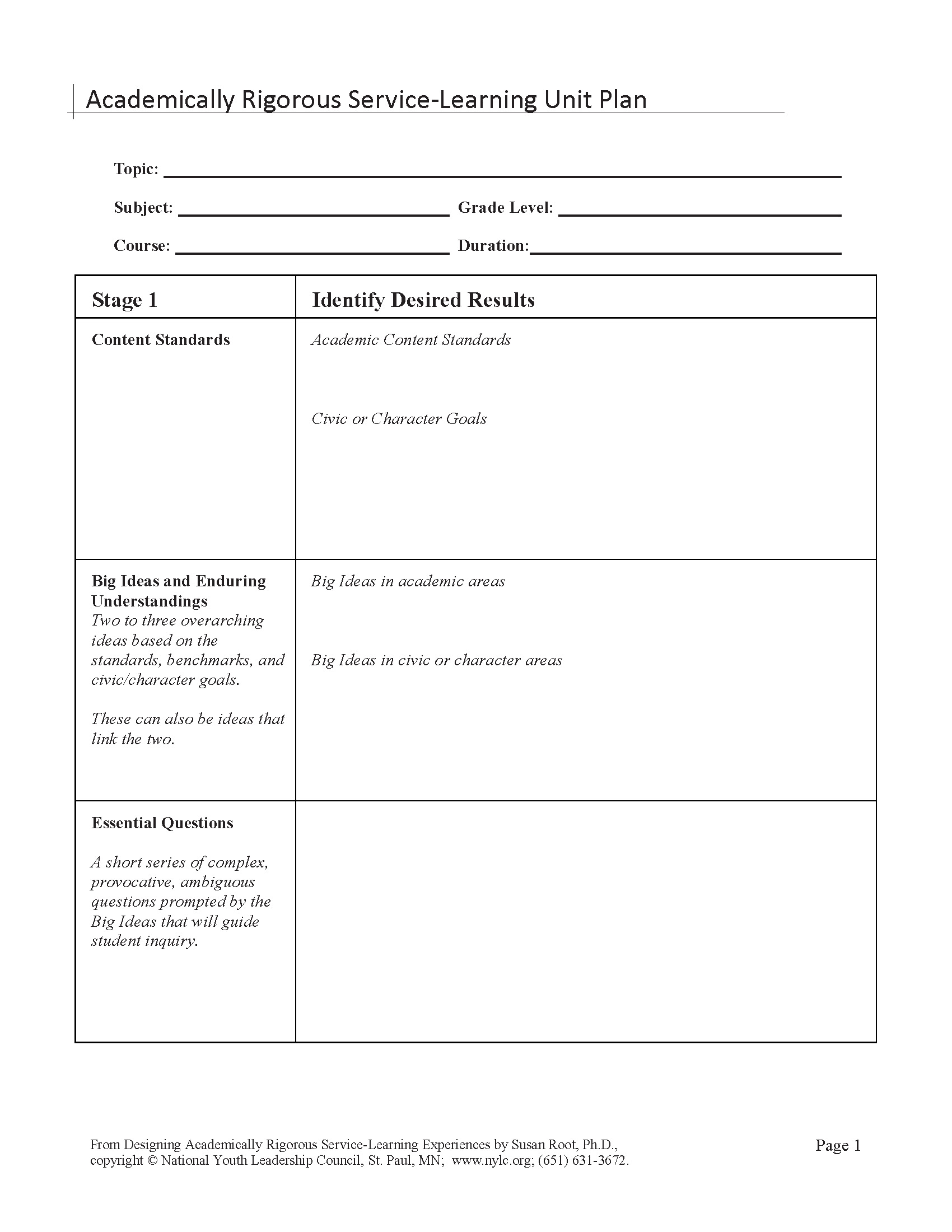
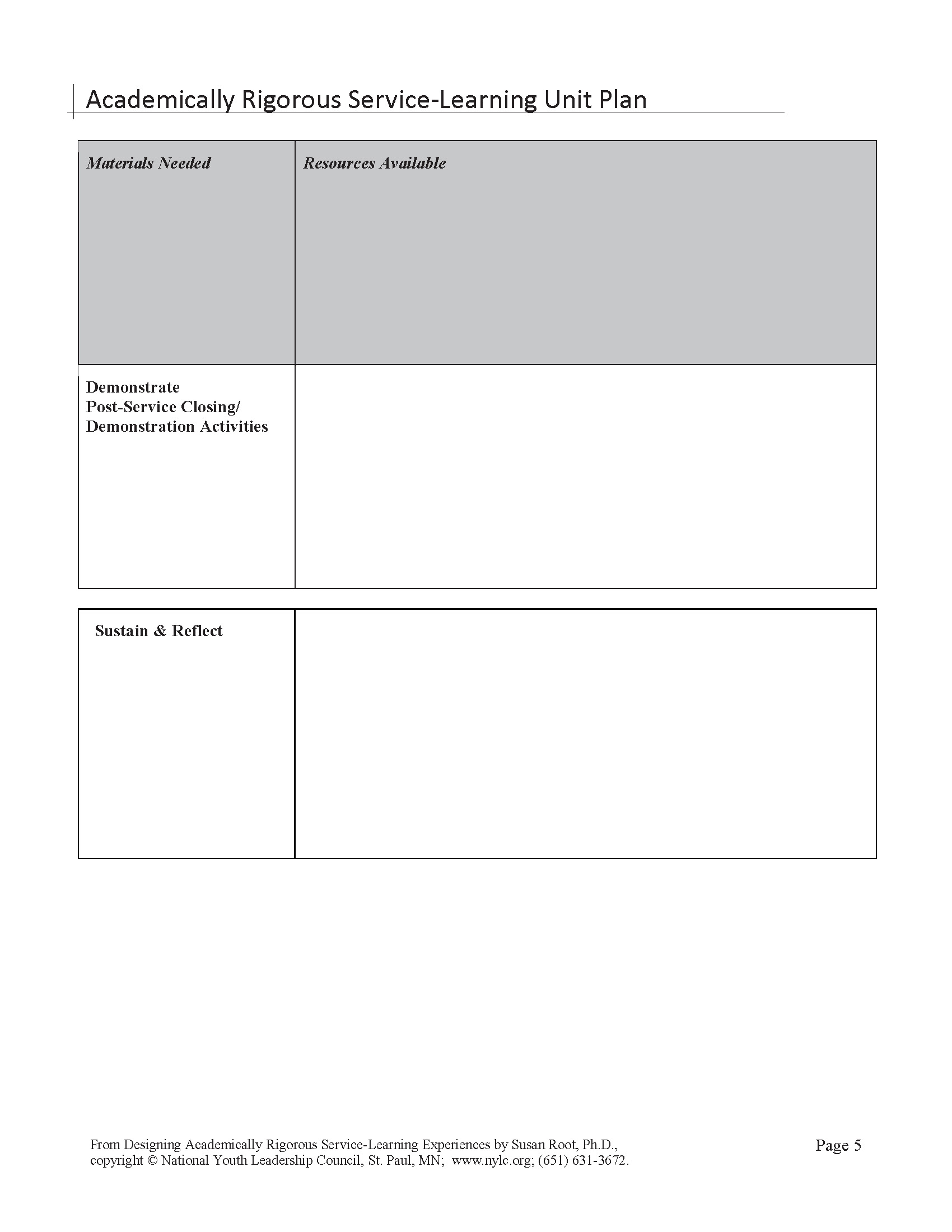
    Hence, NYLC wants to create an interactive project planning tool to guide teachers through the planning process to ensure that service-learning is planned with quality. Our past Research Director, Susan Root, used Grant Wiggins and Jay McTighe’s Understanding by Design to create a planning form and supporting trainings that we believe leads to quality service-learning projects.

    NYLC SLPlanning doc_Page_1 NYLC SLPlanning doc_Page_2 NYLC SLPlanning doc_Page_3 NYLC SLPlanning doc_Page_4 NYLC SLPlanning doc_Page_5

    Here is the challenge, educators (in particular those serving in a formal pre-K through 12 settings), only represent a portion of who will be using this tool. We want this tool to be applicable and useful for all of our members which includes youth ages 13-24 and adults who do not serve as a K-12 educators (including Higher ED). We need to modify the process so that everyone can relate and understand the process no matter what setting they are in.

    Not everyone who is using service-learning has a curriculum to base the project on. That being said, they still should have defined goals and outcomes for the participants (even if they are the participants) before they begin the project. For example, a student group may decide that they are looking to grow as leaders. In particular, they would like to grow their skills and knowledge related to public speaking and project management. They would create clear goals and outcomes for that growth before the project begins.

    To appeal to a large audience this tool also cannot look like a blank worksheet, in fact I am not sure what audience that would ever appeal to. One tool that was created 3-4 years ago was Lift. Lift is a multimedia tool that follow three schools (one elementary, one middle, and one high school) from around the country that NYLC believes has an exemplar service-learning program. The tool is colorful, has dynamic videos, downloadable resources, and reflection questions. People from around the world call upon the Lift to see what the K-12 Service-Learning Standards for Quality Practice look like in person.

    There are some problems with the tool. The first being that it is built in flash and not accessible for many mobile devices, making it difficult to access for some. The second is that it is yet another website for NYLC to maintain and takes people away from the GSN. The videos and content within the site are not easily changeable; in order to add new schools many videos would need to be re-edited. NYLC staff does not have access to add and remove tools from the site. The Lift also needs to appeal to a large audience but in doing so leaves out opportunities to feature content that specific audiences may find helpful. For example, there is a lot of video of students in-action planting trees and working collaboratively but less of the instruction in the classroom.

    In a past blog you saw an overall concept video that I shared with the RFP bidders. Building on the design in that video, the next few posts highlight more in-depth planning of the project-planning tool (which seriously needs a new name). Using all of the inspiration and lessons-learned above.

  • Big Bad Badge Plan

    Big Bad Badge Plan

    Hopefully, by now through the blog my readers have an idea of my large-scale vision for the digital badges and project-planning tool. The further the project moves forward, the more details I need to figure out. The bidders for the RFP had a lot of great questions for me and through providing answers my plan begins to build. Specifically what badges we want to offer is something I have been grappling with for some time.

    In the fall of 2013 through my practical research course I created a research proposal that stated I wanted to increase autonomy, relatedness, and competence in which based on the Self-Determination Theory created by Edward L. Deci and Richard M. Ryan.  I am arguing would hopefully increase motivation for our members. Motivation for what? Well motivation to participate in NYLC’s programs both online and in-person and our programs. Our programs are based on NYLC’s mission which is:

    to create a more just, sustainable, and peaceful world with young people, their schools, and their communities through service-learning.

    I have struggled through this argument a few times because Deci, Ryan, deCharms, and others have wrote about the effects of using rewards and the effect it has on extrinsic vs. intrinsic motivation. Not considering the power that badges could have, especially if we as an educational field can build common ground around the worth and value exchange of badges. In the least, if you consider offering badges to my members for their actions is almost like giving them a special cookie every time they do something I want them to do. What do I want them to do?

    Engage with their peers, learn more about a powerful pedagogy, make plans to make the word a better place, share their knowledge and expertise, change the lives of young people whom they work with everyday by showing them that they have power and voice in this world. If initially, my members engage more because of the badges, the rewards, the external acknowledgement, I don’t care. I have seen lives changed, professions refreshed, and classrooms, schools, and districts turned around completely because of the use of service-learning as a powerful teaching strategy. That is where the intrinsic rewards will come through.

    Let me cautiously jump off my soapbox quickly to show you my plan for the digital badges. I shared in my earlier blog post that I loved how Buzz Math organized and shared the details of how to earn badges. In retrospect, my only addition to that and maybe this is possible once you actually sign into Buzz Math is that I would love for you to see exactly who has earned that badge.

    The first step in designing the badges was creating a logic model. This is my first attempt and there may be some holes in my theory but somewhere to start and discuss:


    Badge Logic Model

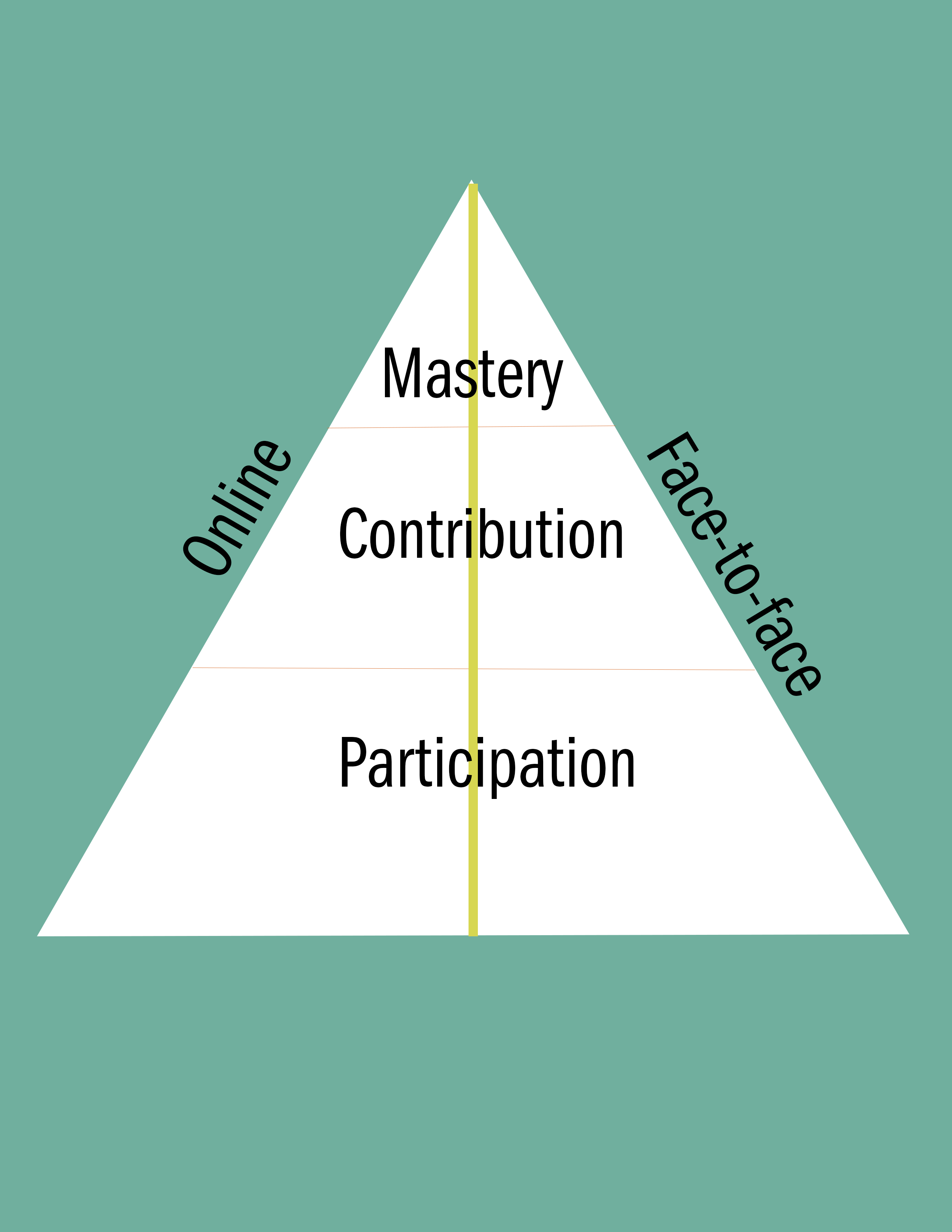
    From there I move to design, a few years ago I went to a training on engagement pyramids for non-profits. Using their logic, I modified my pyramid to relate to my needs. This is my engagement pyramid acknowledging member’s behaviors from just being present and participating to contributing and then mastery.

    Pyramind of Engagement 2

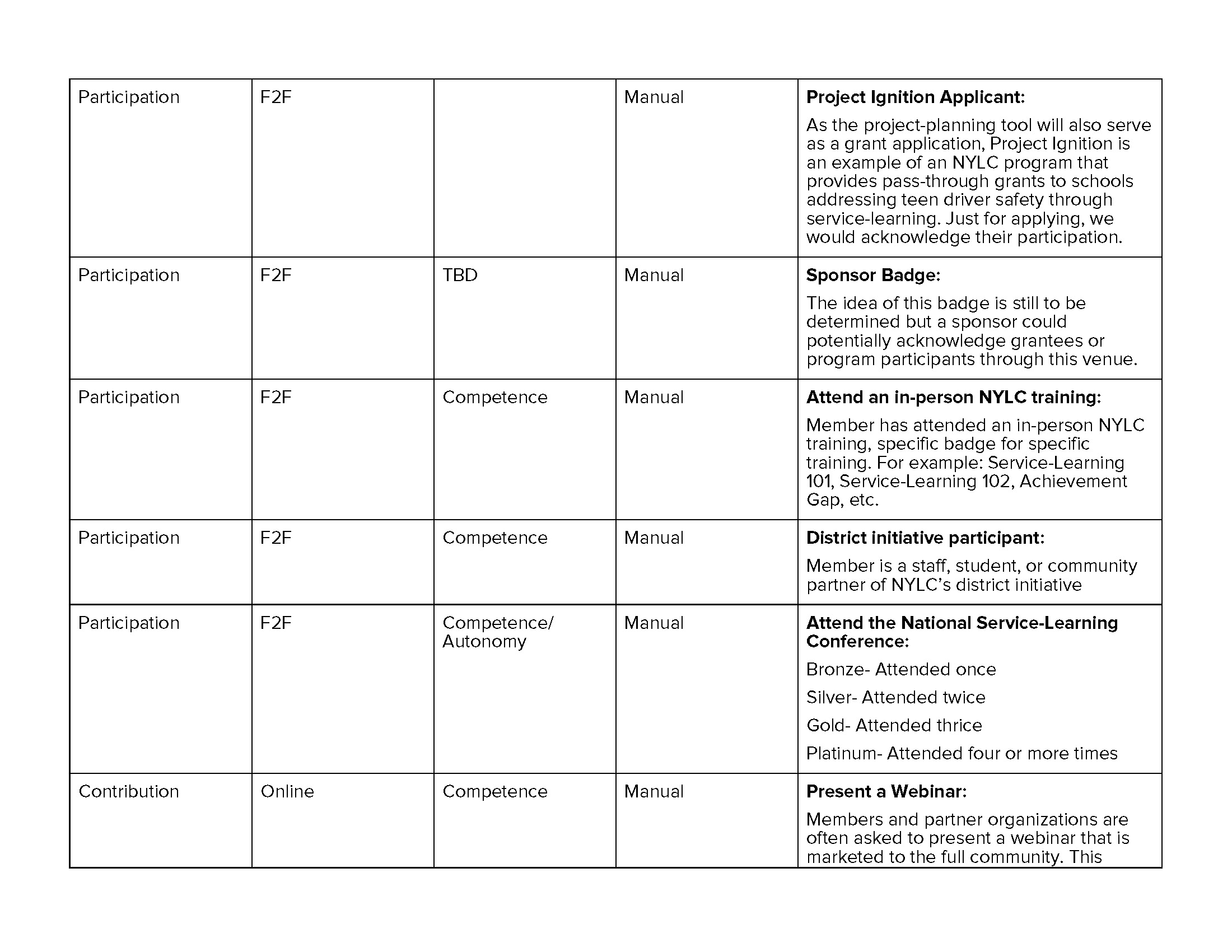
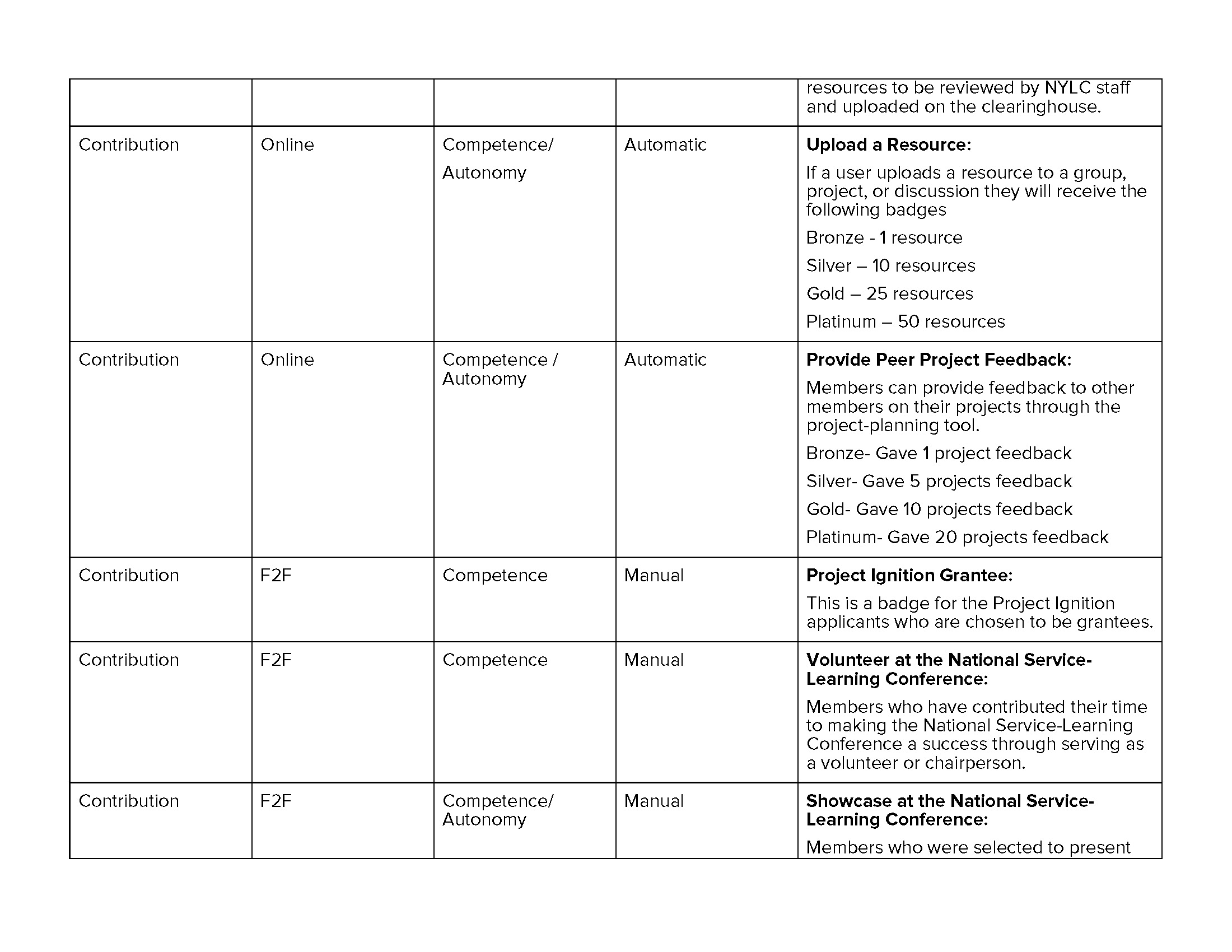
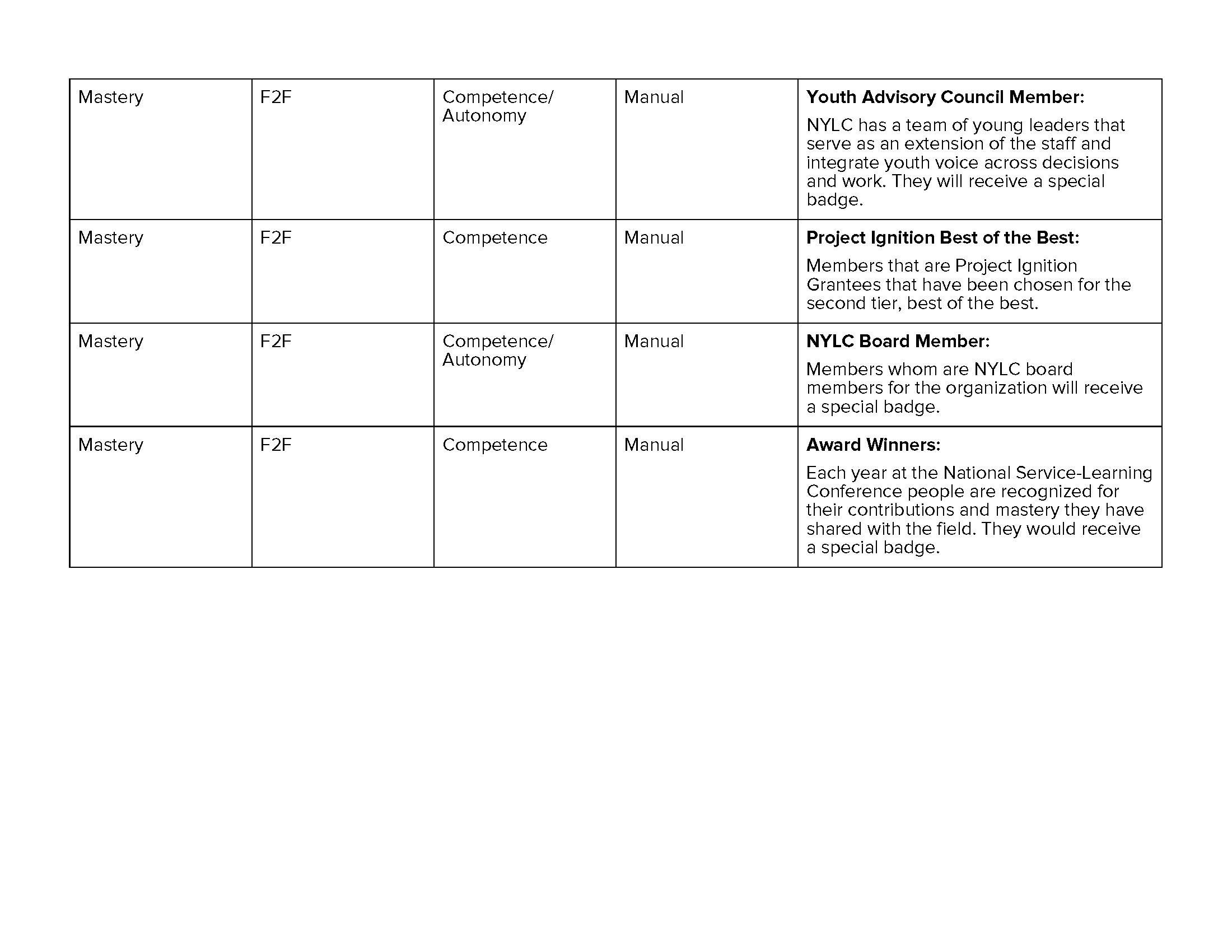
    From there a breakdown of badges in each area I am calling the GSN Badge Matrix. A never-complete guide to the badges that you can earn from both online and offline participation in NYLC’s programming. I say never-complete with pride as we continue to build and grow at NYLC. As we develop more online tools, events, trainings, and programming we want badging to be a core element across. Thus this badge plan will always serve as a working document.

    Badge Matrix_Page_1

    Badge Matrix_Page_2

    Badge Matrix_Page_3

    Badge Matrix_Page_4

    Badge Matrix_Page_5

    Badge Matrix_Page_6

    Badge Matrix_Page_7

  • Answers Vlog

    Answers Vlog

    Thanks to an old colleague who was willing to be contracted quickly we were able to answer the technical questions for the bidders, the answers do not make for the most riveting blog post but comment below if you disagree. For the content related questions, I created the video below using the assignment I had created in CI 5336.

    Follow up questions after the video:

    Will we need to plan for payment processing on the NYLC assessments? Online checkout, etc? I’m guessing no, but I want to make sure.

    Yes, actually that would be the ideal if people could submit their payment right in the module. I am not sure how else it would work without a lot of extra administrative work. The simpler the process the better.

    For Badges, how many categories and how many actual badges do you envision overall? (5 categories, with 4 levels of badges each -bronze thru platinum).

    On the last slide it indicates at this moment, how many badges we are planning on distributing. The badges with the blue text indicate that it would likely require us uploading an excel and the badges with an asterisk indicate it would be a progressive badge: bronze, silver, gold, platinum (four levels).

    That being said, we want to be able to create our own badges as we go that obviously will not be able to be triggered by anything in the online system but administrators can give out for program related content.

    SCOPE of WORK
    • Is existing codebase viewable? If not full source the Gemfile definition to see full application framework stack.– Did the code I sent you cover this question?
    • What is the current state of test coverage?
      • What test frameworks used? (Rspec, Cucumber, etc)– Cucumber
      • What coverage exists? (unit, functional, etc) integration, unit, and performance
    Project Plan
     
    • Interactive modules with supporting resources and videos
      • What are all the resources you want to support? (video, audio, text, etc) Video, audio, text, pictures, PDF and word documents
    • Members will have the opportunity to earn digital badges throughout the project planning process.
      • Is the criteria for these thresholds already established? No, I am assuming they would need to answer all of the required questions to earn the badge for that step.
      • Offline credit upload – What format? (csv, xls, etc) xls
    • Members can publish their project to the site at any time, request feedback, and print.
      • Through the editing process, what sort of data retention is required?  Drafts, published versions, etc. I think their responses should publish as soon as they share them, even if they decide to go back and change them. I think anytime they make a change to their project plan whether it is additions or changes it should automatically save.
    • The fifth module is a peer assessment where members can elect to have their project peer assessed.
      • Does this process already exist (assumption is the Service-Learning Self-Assessment is a pre-existing tool/system). Attached.
      • What does this entail? Rankings?  Written feedback, etc. Rankings, and written feedback but the member assessing must be able to see the evidence and the user plan at the same time they are assessing.
    • Updates to the project can be made at any time by users.
      • See data retention/drafts question above.
    • Every section of the project plan can be updated at any time with evidence from the member.
      • Is the evidence made up of the same resources attributed to the project during creation? (video, audio, text, etc) Yes, Video, audio, text, pictures, PDF and word documents
    Grants
     
    Are there more details available for this portion of the project?  Current assumptions from the video are:
     
    • Grants are available for a limited about of time. Yes
    • Any project can apply for a grant, as long as it is currently open. Yes
    • There are core Grant questions that are asked of all applicants. Not that I know of at this time, I think depending on the funder, these may change.
    • Each grant can have additional custom information that needs to be submitted.  As such, a flexible form builder will be required that can support creating questions such as:
      • Text/Essay entries
      • Multiple Choice answers
      • Uploading of resources (video, audio, images, etc) Yes
  • Questions Roll In

    Questions Roll In

    The RFP had been floating around the interwebs for approximately two weeks when the follow up questions began to roll in. Since this process is new to me, I was really not sure what to expect. Below are a series of questions that were asked to me through email:

    Where is the site hosted?

    Can we obtain access to the source code, some or all, to review so we know the quality of code we’ll be working with?

    What database does it use?

    Does any of the existing major functionality of the site depend on any 3rd party gems (aside from the core Rails ones)?

    Are they using a CDN (such as Amazon S3) for any storage?

    The expectation that the two new functions of the site (the badges support and the planning modules support) would be integrated directly into the existing site code, or that they would be bundled gems?

    Are there any restrictions on which 3rd party gems can be used the site?

    Is the existing code currently stored in a code repository, such as git or svn?

    How well tested is the existing code on a unit-testing level and on an integration-testing level?

    What testing framework (RSpec, TestUnit, Cucumber, etc.) is used?

    Could you send a copy of the existing code base, schema, or object model? (this would answer a lot of questions…)

    Could you send screen shots, or a login to the current administrative interface? If you have a staging/demo environment, that would work as well.

    Could you provide more detail on how you see the modules behaving? Are there a lot of fields to fill out? Is it one long page? Are there new files/videos/etc for each module?

    Will modules be visible to non-authors? Only after they are published? What all will be visible to non-authors?

    Are the modules linear or can users jump around and complete modules in any order?

    Could you provide examples of how a user completes a module? Can this be done by only the project members, or does a community manager/admin play a role?

    Do you have community managers today? What access do they have?

    Could you provide examples of some of the badges you expect to use?

    How many badges do you anticipate having? Would you like us to provide the design assets for these?

    Could I ask what your target budget for this project?


    Some of those questions I can answer but a lot of them seem to be in a different language. My organization is small but mighty, we are a programs organization focused on youth development. We do big things with a small budget and that budget does not include a lot of IT support unfortunately. Through this process I realized those were questions I should know or at least someone at my office should know but we don’t. What made a difficult situation worse was that the person who did know those answers (our current developer) was also bidding on the project so it was a conflict of interest.

    These questions only represented what was emailed with me. Which is also another lesson learned. I thought in the RFP I was clear on the process but now reading back, I wasn’t. In my ideal world everyone would submit their questions through an email so I could collect them all and answer them all at once through a bidders conference call. Instead I had eight different vendors sending me requests for individual meetings all asking me similar but different questions. In the future, I will be clearer with my directions and stricter on the process because it in end it was more time consuming than necessary.

    Another reflection on all of the questions asked was that every vendor asked different questions. Some had a lot of more tech-based questions, some focused on what our relationship would be, some wanted to know more about the plan for content. There was a lot of discrepancy in the essential information needed to move forward. In general, I learned I needed to be much more detailed in the future.

  • Focus Group Feedback

    Focus Group Feedback

    DSC_0885

    Each year the National Youth Leadership Council convenes the National Service-Learning Conference. This year was the first time the event took place in our nation’s capitol, Washington D.C. Like every other year, the event was inspiring, educational, and energizing featuring speakers such as Sandra Day O’Connor, Philippe Cousteau Jr., and Cassandra Lin. The National Service-Learning Conference is made up of 40% young people under the age of 24 and represents the GSN’s audience of adults and youth engaged in service-learning.

    DSC_0938

    To capitalize on the opportunity we host focus groups each year with a set of youth and a set of adults who are GSN members. Each year our questions shift slightly depending on what we are trying to find information about. This year, given the updates to the GSN we asked about motivation and incentives. While we learned a lot from our members for future updates the two pieces of feedback the stood out related to digital badges and the project-planning tool were certificates and mobile access.

    Educators are required and encouraged to engage in professional development to stay certified and move up the pay scale. In order to prove this, they must have documentation from the professional development organization. This made me realize that every member who earns a badge should be able to print out a certificate with their name on it and an explanation of what they had to do to earn the badge. For students this could count towards school or extra curricular activities as well.

    The second suggestion of mobile access made me realize that I should have required the updates made to the GSN to be mobile accessible in the RFP. The question is, if one part of the site is optimized for mobile use but the other isn’t, is it still helpful. This can be a question for the bidders.

    DSC_0102

  • RFP

    RFP

    After many revisions, brainstorms, procrastinating moments, it is here: the RFP for the web development work on the GSN. It may have taken me a long time because I had no idea what I was doing. It was also difficult because the digital badges and the project-planning tool are two different projects but they will need to interact. There were some resources I called upon in the process.

    The first resource, which I found most valuable, is from the Warehouse Education and Research Council; it gave me a step-by-step process for creating the RFP.

    Some other resources that I found helpful were:

    FivePaths, LLC

    Confluent Forms

    Tech Soup

    Net Dynasty/Priority Net Marketing

    The Nerdery

    So without further ado below is the RFP we published on May 31st, 2014. A special thanks to my boss Susan Valdés, and my colleagues Amy Meuers and Davis Parker for their editing: NYLC RFP 033114

    NYLC RFP 033114_Page_1 NYLC RFP 033114_Page_2 NYLC RFP 033114_Page_3 NYLC RFP 033114_Page_4 NYLC RFP 033114_Page_5 NYLC RFP 033114_Page_6

  • PLN

    PLN

    In my blog about the presentation from Elisabeth Soep I didn’t mention the second half of the presentation. It was a panel of local innovators: Cassie Scharber (moderator), Marika Staloch, Youth Services Director, St. Paul Public Libraries; Jenna Sethi, Youth Studies, University of Minnesota, Delania Haug, Teacher, South High School, Minneapolis.

    DSC_0894

    While all of the panelists had interesting things to say Marika Staloch announced that the St. Paul Public Libraries had received a grant from MacArthur for an innovative learning lab. The learning lab will be the in-person center for city-wide programming where young people can be supported through courses and caring mentors. As a part of this growing programming St. Paul will also be distributing badges.

    BADGES?!? I am doing badges too! Please, be a learning friend. So of course I tracked Marika down after the presentation and asked if we could connect. She referred me to her colleague Leslie Spring, Library Associate at St. Paul Public Libraries. Leslie and I made a plan to meet up for coffee and she invited a colleague she was working with on their badges, Gary Leatherman, owner at macMonkey Digital Studios.

    photo_2-3

    The first time we met we shared about our programs and goals. I shared about the Generator School Network and how I was currently writing an RFP for the badge integration. Leslie shared more about the program Marika introduced and some other connections with the Northstar Online Digital Literacy Assessment. Gary shared about some of the online platforms and curriculum he had experience with.

    The second time we met we focused more on the technical aspects of the Open Badges platform. Leslie is lucky because essentially she gets to build her website from scratch and can choose a website platform that works best with Open Badges. I need to make it work with what I have, not that the GSN isn’t great but there are other types of websites that would maybe be easier. Gary is very helpful in this area because he stays up to date with the tech calls and can speak the lingo.

    The advancements in Open Badges continue to happen all the time. This is wonderful considering it is free but also difficult because you need to make decisions based on the current technological capabilities. In a few months, there may be an update that could have saved you a lot of money from paying a web developer to create a custom solution.

    photo_1-3

    What this means for my work

    It is wonderful having a local personal learning network that I can call upon to learn and grow with. Continuing to call upon my growing tech network will be essential for the best design and implementation possible. Our coffee conversations have stretched my knowledge of Open Badges and challenged me to think of alternative solutions for my design.

    Also, more meetings at Groundswell in St. Paul. They serve bacon, gruyere, rosemary scones.

  • Buzz Math

    Buzz Math

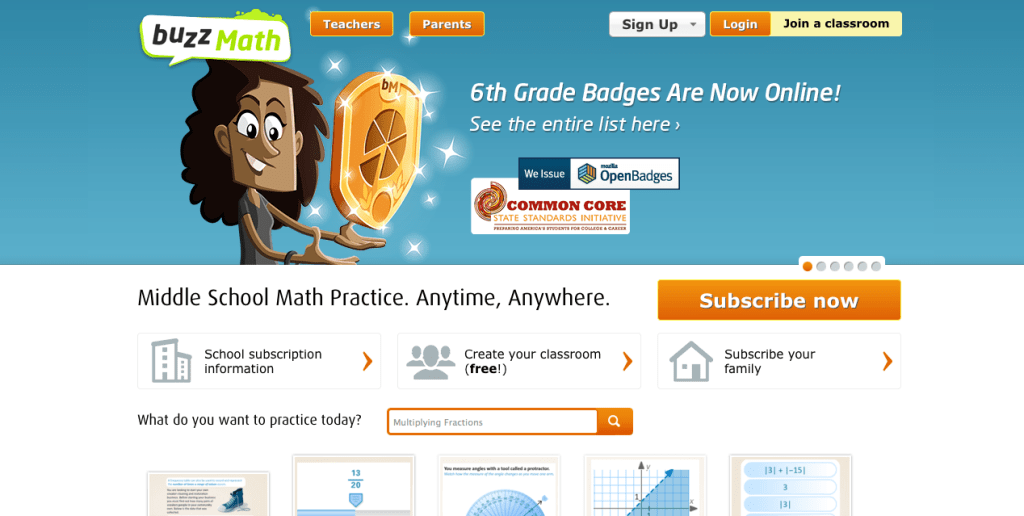
    On March 12, 2014 I listened in on a presentation from Jean-Phillippe Choinière of Buzz Math. Buzz Math is a proprietary website that leads middle-school students through a series of Common Core aligned math challenges. Students can sign up through their school or through their family and whatever adult is working with them can see their progress through a dashboard.

    Etherpad Presentation

    Call Recording

    Jean-Phillippe’s Slides

    Many things intrigued me about this site, one is that is was a for-profit site using Open Badges. I hadn’t yet seen an example of that and although it does have and education focus it is not free. Two is that it is up and running; I say this because a lot of presentations I have seen are about future plans or theoretical conversations around badges and it was interesting to see a site that had a lot of momentum. Thirdly, and what has really stuck with me is the look and organization of the site.

    Screen Shot 2014-05-02 at 9.13.10 PM


    via Buzz Math

    As soon as you visit Buzz Math you are welcomed with vibrant but clearly branded colors. There are cartoon figures keeping it fun and representing a diverse group of people. The page that inspired me the most was the badge overview page that listed all of the badges that are possible to earn. They broke all of their badges into three categories: content knowledge, process knowledge, and achievement. While the computer can calculate content knowledge and achievement the teacher or adult facilitator gives out the process knowledge badges.

    Screen Shot 2014-05-02 at 9.16.03 PM

    via Buzz Math

    The design of the badges is sleek, branded, and progressive. By progressive I mean the badge changes as you earn more within the same area. For instance some badges have a number that changes as you reach certain milestones or some badges begin as bronze then move to silver, gold or even platinum! That way you can push your users to higher engagement or more math knowledge if that is your focus.

    When you click on any of the badges in the badge overview section you are able to see the description of the badge, how many people have earned that badge, what a user needs to do to earn that badge, and if applicable, what Common Core Standard it represents. I would love to do a similar library keeping in mind that I would like some of the badges we want to offer to be a secret. Similar to playing a video game and you win a bonus or an extra life you didn’t even know was there.

    Screen Shot 2014-05-02 at 9.18.06 PM

    As Buzz Math members earn their badges they sit on a literal virtual shelf on the member’s profile. Each shelf is labeled content knowledge, process knowledge, or achievement, which is an interesting idea. I am not exactly sure how I could label different categories of badges, I have categories but I am not sure if it would be keen to share that information with my members.

    Another thing to note would be that Buzz Math does not just award badges but stars. The stars acknowledge smaller achievements and often lead to badges but can also let a student know how far through the challenge they are.

    What this means for my work

    I believe I shared this in the following paragraphs but to reiterate I will include a badge library where members can learn more about all the badges offered. Each badge will have a clear description of what needs to be done to earn that badge, a description, and some information about how many people have earned that badge. Many of our badges are progressive and will hopefully encourage members not to just participate or contribute once but continue to engage within the com

  • Equity and Digital Badges

    Equity and Digital Badges

    In my last blog I shared about two calls that happen weekly that are moderated by Mozilla. I have been participating in these calls sporadically for the past few months. They are recorded, which is convenient because attending the live call is not always possible. On February 26th, Ugochi Acholonu a postdoctoral research at DePaul University shared work that her and Dan Hickey, a professor at the University of Indiana on the difference between equity and access. This call is prime example that there are many, many layers that need to be considered and researched related to badge design, program design, and evaluation.

    Etherpad notes and Call Recording

    Acholonu gave an overview of the 2013 Chicago Summer of Learning, which is a program that promotes both summer learning. Some youth participated independently online, and other youth as a part pre-existing youth programming and education both online, hybrid, and in-person. Digital badges were used to document and acknowledge participation across the spectrum and across the city.

    The researchers on the project were able to identify four different groups of participants and their findings show that those who were “self-directed” or students who joined on their own and not a part of a larger program stopped engaging with the program quickly.

    See slide 10

    This finding is what drove Acholonu and Hickey to think about the difference between access and equity. All the students both working independently or within a larger program had the access to earn the digital badges but their pathway to those badges were not necessarily equitable because some had better structure and adult mentors to support them. Students from different backgrounds also bring a different perspective and interest to the topics that need to be explored in order to earn badges.

    For next year the researchers recommend increased online mentorship and recommendations for students who are participating independently. Also, thinking more holistically about the organizations that the Summer of Learning outreaches to.

    Questions for Ugochi Acholonu (the questions listed below are copied from the etherpad, her answers are summarized by me):

    Yet it seems that ‘access’ is limited to “access to learning.” How about access to recognition of what the person already is (past) and dreams (future).- Serge Ravet

    Answer synopsis: If there is a badge that is offered and the youth already had experience in that area and could prove it through some sort of evidence then a badge was issued. My side note: For instance, if it was a video editing badge and a young person already knew how to edit videos, they would just upload their video to earn the badge.

    Is it true that students have access to the same resources? What if they don’t have technology access?  How do they get access to the resources? – Karen Jeffrey

    Answer synopsis: Acknowledged the access is an issue as well as budget to address the issue. Drop in sites especially libraries were offered but transportation to those locations can also be an issue. “I don’t think access comes before equity, I think you have to talk about access and equity at the same time”. In the design of the program organizers chose free programs for the badge challenges as to not create barriers for students.

    Carla Casilli (Mozilla call organizer) reminded the group that badges do not necessarily need to be digital badges.

    What does this mean for my work?

    Service-Learning is most prominent in schools that are more affluent, including private schools. As a pedagogy service-learning has proven to be effective with high risk populations because it creates an engaging educational environment. Our organization is making a concerted effort to focus our programming on high-risk and minority populations.

    As we start to use badges across our programming, how are we ensuring access to the Generator School Network? Are we creating an equitable incentive system if students are unable to sign on regularly? This issue might be best addressed by working on a plan with the schools we work with closely. It seems it would also be keen of us to adopt the strategy that Acholonu shared about tailoring badge design to appeal to the populations we are looking to engage.

    That is one of my biggest struggles is that the GSN serves a very broad range of people based on age, location, education affiliation (K12, Higher ED, out of school time, etc.), background, experience with service-learning, etc. Once the badging system is underway our organization should look to see who is reacting (if anyone) positively to the badging system and who we may need to outreach to.

    It is not surprising that the students who were working independently dropped off quickly. Whether you are an adult or young person independent learning can be very difficult and takes a lot of passion and/or a skill set for time management and resourcefulness. Online we could offer more pathways to learning so that the process is not so overwhelming.

  • Where are my badge people?

    Where are my badge people?

    Where are my badge people?

    Discussing (in depth) digital badges is something that not something everyone can or is interested in doing. Especially as the development and research around this ED tech movement gets more complicated and advanced. I felt like I was on an island working in isolation without anyone to really discuss the implications for my organization’s website and the broader use.

    After a bit of searching I came upon HASTAC

    Screen Shot 2014-04-29 at 7.41.08 AM

    HASTAC is an alliance of more than 13,000 humanists, artists, social scientists, scientists and technologists working together to transform the future of learning.

    via HASTAC

    Essentially it is an online community of graduate students and professors (and others) from around the field interested in talking about the latest movements and innovations in education and technology- WHAT? That is me. One of the most robust topics on HASTAC was about digital badging and helped me see some of the conflict on the topic.

    Because the community and some of this research is well underway you could spend weeks reading the blog posts of field leaders such as Daniel Hickey, Cathy Davidson, and Sheryl Grant. Grant curates a lot of the badge information on the site including this bibliography, which I found particularly helpful when creating my research proposal.

    I reached out to Grant to find out more about digital badges, share some ideas I had around my research paper, and find out more about her role at HASTAC. It wasn’t a formal interview so I won’t quote her but I found her very helpful and she recommended a lot of resources and people to read. She shared that there is two weekly calls hosted by Mozilla, one more research/system design focused and the other a community call. While I prefer to be on the live call, they do record all of the activity within their Etherpad.

    These calls have been essential for my growth in CI5190 and for my job at NYLC. My first call was in January, Neil Price of the Boys and Girls Clubs of Canada giving a presentation on Badges in the Afterschool Space. Hearing someone explain his design process in relation to his programming made me want to jump out of my chair with excitement. I am not alone! And there are people willing to share ideas, challenge each other with thoughtful questions, and move the practice forward.

    The calls have stretched my understanding of digital badges and the multitude of research topics around them: assessment, motivation, social currency, program design, access and equity, etc. This list truly goes on an on, now my challenge is how I can get more involved.


  • Digital Badges?

    Digital Badges?

    Now that I have shared about the website I work on, and our impetus for integrating digital badges. I want to ensure all my readers know what I mean by digital badges. There is a lot of media and reports on digital badges, below are some of my favorite resources. That being said, what I have shared in previous posts and what I hope is clearly illustrated below is that there is still a lot we do not know about digital badges.

    Definition:

    “A badge is a symbol or indicator of an accomplishment, skill, quality or interest. From the Boy and Girl Scouts, to PADI diving instruction, to the more recently popular geo-location game, Foursquare, badges have been successfully used to set goals, motivate behaviors, represent achievements and communicate success in many contexts. A “digital badge” is an online record of achievements, tracking the recipient’s communities of interaction that issued the badge and the work completed to get it. Digital badges can support connected learning environments by motivating learning and signaling achievement both within particular communities as well as across communities and institutions. (Source: Erin Knight White Paper)”

    From: https://wiki.mozilla.org/Badges

    To follow that definition, I would like to share a video I created in the fall semester of 2013 in CI 5331, Introductions to Learning Technologies taught by Aaron Doering. This was an issue paper assignment and the Youtube was the oral presentation of the research paper.

    In my video I outlined research being the key issue for digital badges. There is some research being done and thankfully funded by some great foundations. But we still have a lot to learn about the design and use of digital badges.

    The next video is the announcement of the 4th Annual Launch of the MacArthur Foundation Digital Media and Learning Competition. This iteration of the competition specifically focuses on digital badges. You may not be interested in watching the whole video; I found this video while reading Secretary of Education, Arne Duncan’s remarks. It was nice to see his speech in the broader context of the event. His remarks are at 22:20 but can be read on the U.S. Department of Education’s website.

    This video, was posted on September 16, 2011 and I shared it because I believe it encapsulates the hopes that government, for-profit, foundations, non-profits, and schools have in digital badges.

    Quote from Secretary Duncan:

    “We’re excited that, this year, this competition will serve as a catalyst to advance the potential of digital badges. Badges can help engage students in learning, and broaden the avenues for learners of all ages to acquire and demonstrate – as well as document and display – their skills.

    Badges can help speed the shift from credentials that simply measure seat time, to ones that more accurately measure competency. We must accelerate that transition. And, badges can help account for formal and informal learning in a variety of settings.”

    And while I share in that excitement of the potential digital badges (3 years later) have on education in a wide variety of contexts. I cannot help but understand where some of the skeptics were coming from. Sheryl Grant of HASTAC outlines some of the badge supporters as well as skeptics in her post Badges are Made of People: The Social Psychological Motivations of Badges.

    How does badging work?

    Here is an infographic created by Mozilla OpenBadges, a free software that can be used by anyone. Mark Surman Mozilla Foundation introduced the OpenBadges software development at 14:30 in the video above but there has been quite a bit of progress since then. Mozilla Open Badges is not the only way to distribute badges but again it is the free and widely used non-proprietary software. Here is how it works:

    800px-Open_Badges_napkin_sketch

    From: https://wiki.mozilla.org/Badges

    Additional Badge Resources:

    Alliance for Excellent Education’s report Expanding Education and Workforce Opportunities Through Digital Badges.

    HASTAC.org’s collection of digital badge related blog posts and resources.

  • Winter Wonderland with Dr. Elisabeth Soep

    Winter Wonderland with Dr. Elisabeth Soep

    http://www.mprnews.org/story/2014/02/20/snowstorm

    February 21st, 2014 was a rough day for Minnesota, there was a lot of snow and it was very cold; school was canceled and a lot of employers told their staff to stay home. This winter, we were used to it and while working from home sounded WONDERFUL… it was Dr. Elisabeth Soep’s presentation was at the U of M that morning. Titled Youth Productions in Digital-age Civics, there was truly no way I could miss that as it combines my love for technology and service-learning.

    So after getting my car stuck, getting it pushed back in by the garbage men, learning the bus schedule real quick, I was there! I am so glad I didn’t let the bad weather stop me from going to the presentation. After an inspiring or knowledgeable speaker, meaningful experience, or life-changing event do you ever physically feel your perspective shift? Your mind starts racing with new ideas and you feel like your blinders have at least been opened up a bit more? That is how I felt after listening to Dr. Soep.

    DSC_0892

    To listen to her full presentation, visit the LT Media Lab’s Livestream. For me what I particularly appreciated about Dr. Soep’s presentation is that she can speak from both a current practitioner and researcher’s perspective. I think sometimes the barrier between these two areas can cause progress to be stifled. Seeing that Dr. Soep has grounding in both areas makes her work very authentic and interesting.

    As a practitioner, Dr. Soep is the Senior Producer for Youth Radio, “an award-winning media production company that trains diverse young people in digital media and technology”. If you listen to NPR you most likely have heard of Youth Radio as they serve as NPR’s official youth news desk. In this role she supports young people in creating and telling their news stories. She also worked with a young person to co-found the App Lab. As an evaluator, Dr. Soep is the Research Director for Youth Radio, “we are a youth driven organization with a research agenda”. Her 20+ years of research experience studying ‘what works’ in supporting young people through media creation and participatory politics is a resource to us all.

    Throughout the presentation Dr. Soep shares mistakes and successes she has had in both of her roles and then shares concrete tactics based on research around participatory politics. As a practitioner, I found her the tactics helpful in bringing best practices to life in our programming at NYLC. After the presentation she published, Participatory Politics: Next-Generation Tactics to Remake Public SpheresAfter hearing her presentation, I started reading publications and watching webinars from the Youth Participatory Politics Research Network. It is a goldmine of resources for youth workers and youth organizations whose goal is to support their youth in being active citizens.

    What does this mean for my work?

    The research coming from the YPP Research Network, such as Dr. Soep’s will be essential for designing and defining my organization’s programming at a national level. Educational technology and project-based learning are on the mind’s of educators and administrators everywhere. Dr. Soep’s tactics clearly explain what that can actually look like in practice and what are some of the risks.

    It is our programming that defines what will we offer badges for in both face-to-face and online settings. That being said, using Dr. Soep’s and other researchers framework for designing our online network will ideally create an environment and supporting activities that allow young people create and share meaningful media. Meaningful media that is connected to real world issues that young people feel passionate about to educate and mobilize others. There are a lot of opportunities to teach digital literacies in both youth and adults so that media is not abused and calls to action are just.

    As a professional in the service-learning field this research needs to be more broadly shared and I hope to bring it to our National Service-Learning Conference in April, 2014- stay tuned on a update on that.

  • And we’re back…

    And we’re back…

    Small bump in the road and lesson learned. But now the GSN is back, better than ever. We updated the Ruby on Rails platform the site is built on, it has a new fresh look, and we uploaded 2,000+ resources that we acquired from a federal program that is no longer funded. To ensure that the content is discoverable we opened up half of the site so that search engines can locate resources.

    Before I get too far into my project, this might be the perfect time to give you a tour of the space.

    The GSN is a 3,600+ member (and growing) online community comprised of young people and adults ages 13+. The dashboard gives an overview of the latest happenings on the website, a scrolling banner of the latest information, and a feed of upcoming webinars and the latest tweets.

    www.gsn.nylc.org


    Screen Shot 2014-04-29 at 7.06.55 AM

    Screen Shot 2014-04-29 at 7.07.34 AM

    The sight is broken into four main areas: Clearinghouse, Learn, Plan, and Connect

    Clearinghouse houses all of the aforementioned resources that we recently acquired and serves as an unbiased showcase of the service-learning field’s resources. It has a robust search function to help users find exactly what they are looking for.

     www.gsn.nylc.org/clearinghouse

    Screen Shot 2014-04-04 at 10.00.26 AM

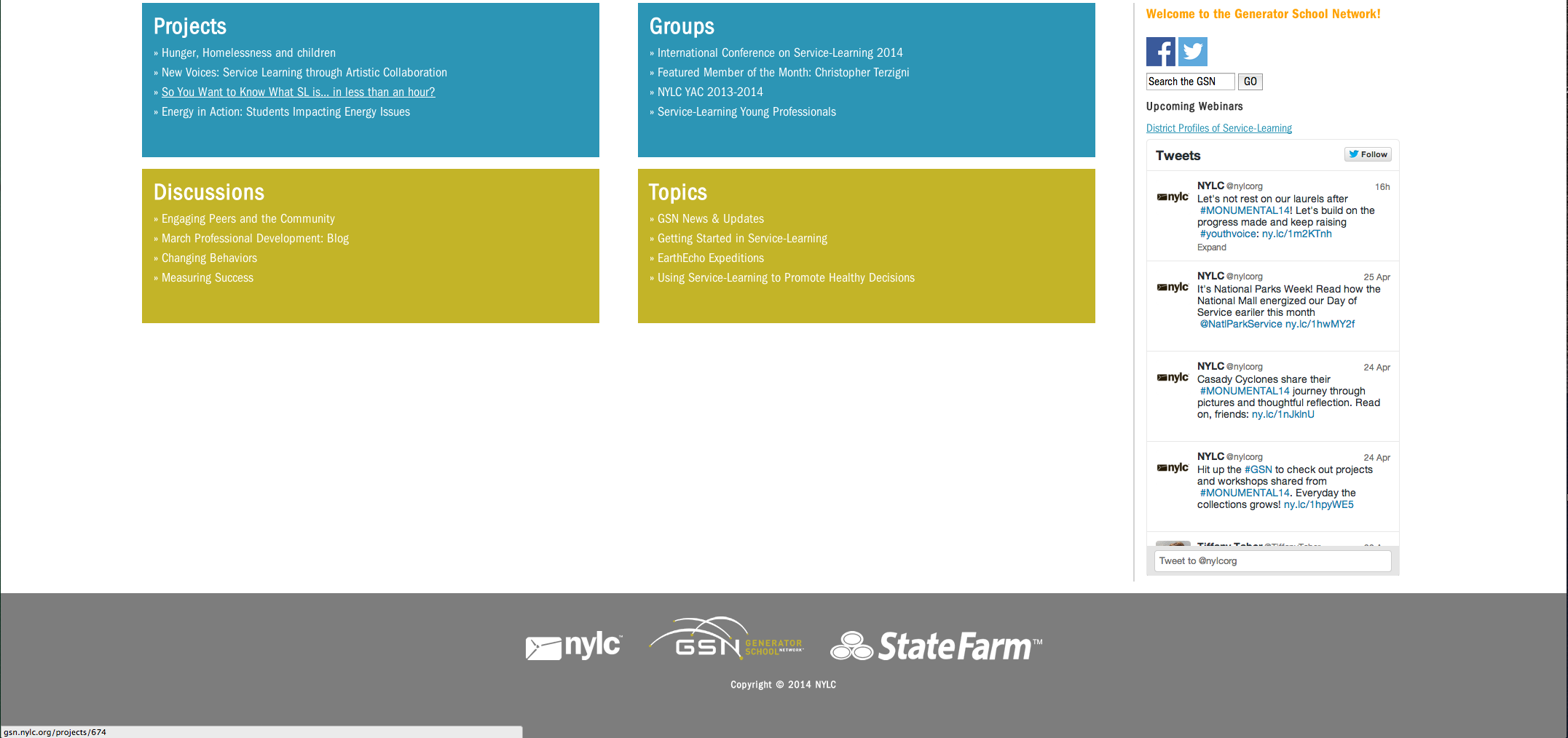
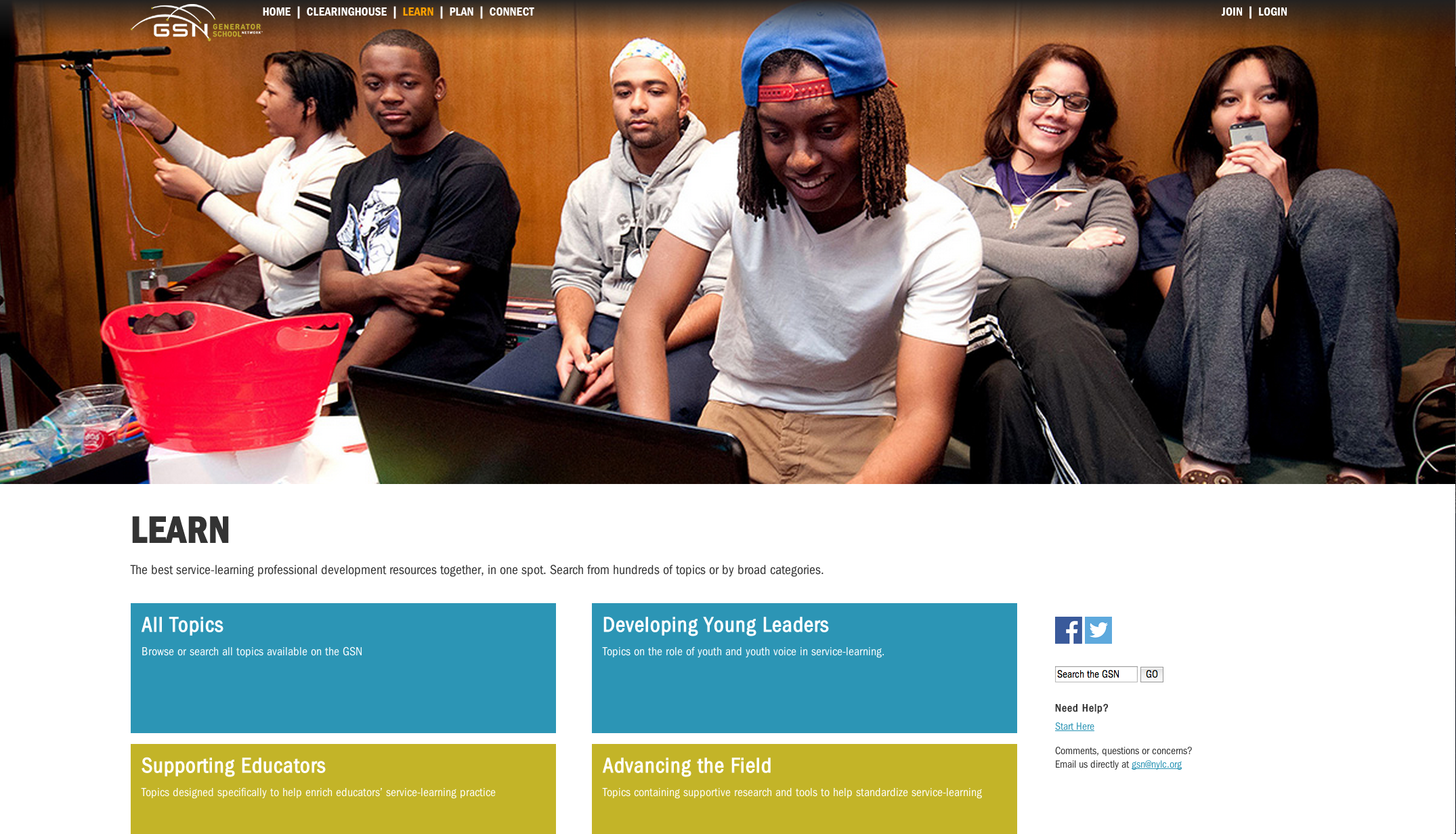
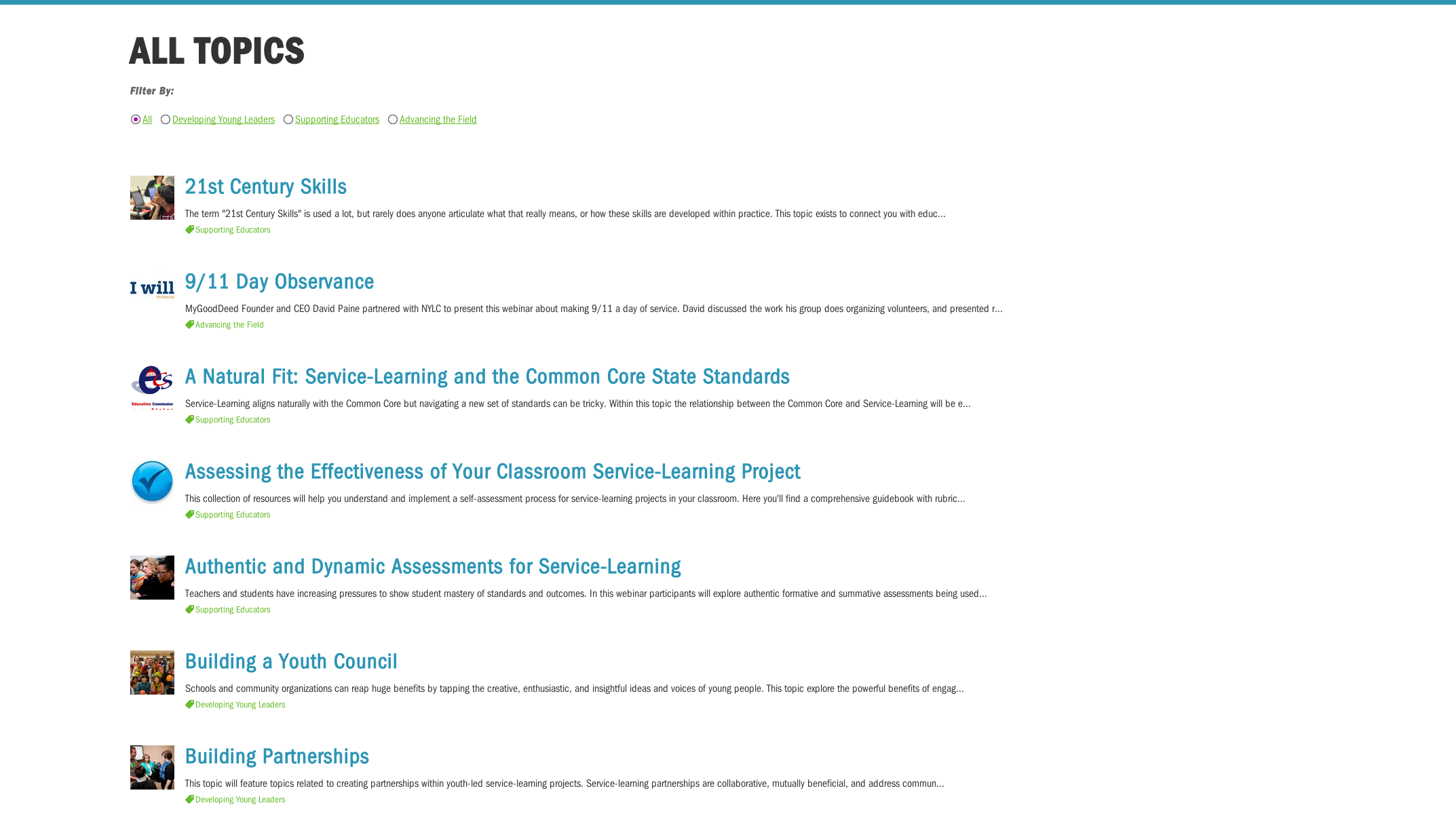
    Learn is where we at NYLC upload all of our free professional development resources including, recorded webinars, downloadable resources, and discussions. We organize this area in different topic areas.

    www.gsn.nylc.org/learn

    Screen Shot 2014-04-29 at 7.08.17 AM

    Screen Shot 2014-04-29 at 7.10.19 AM

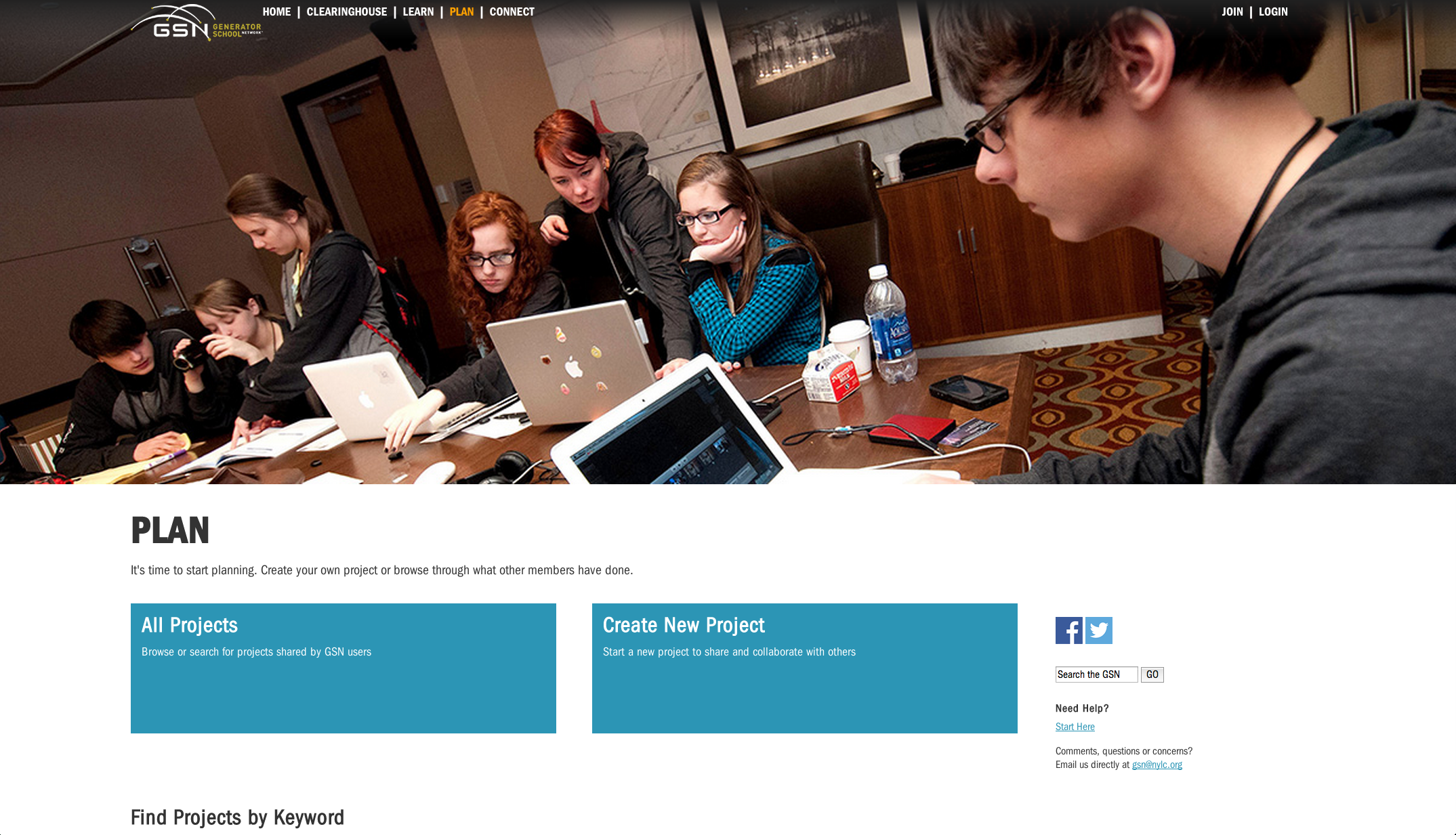
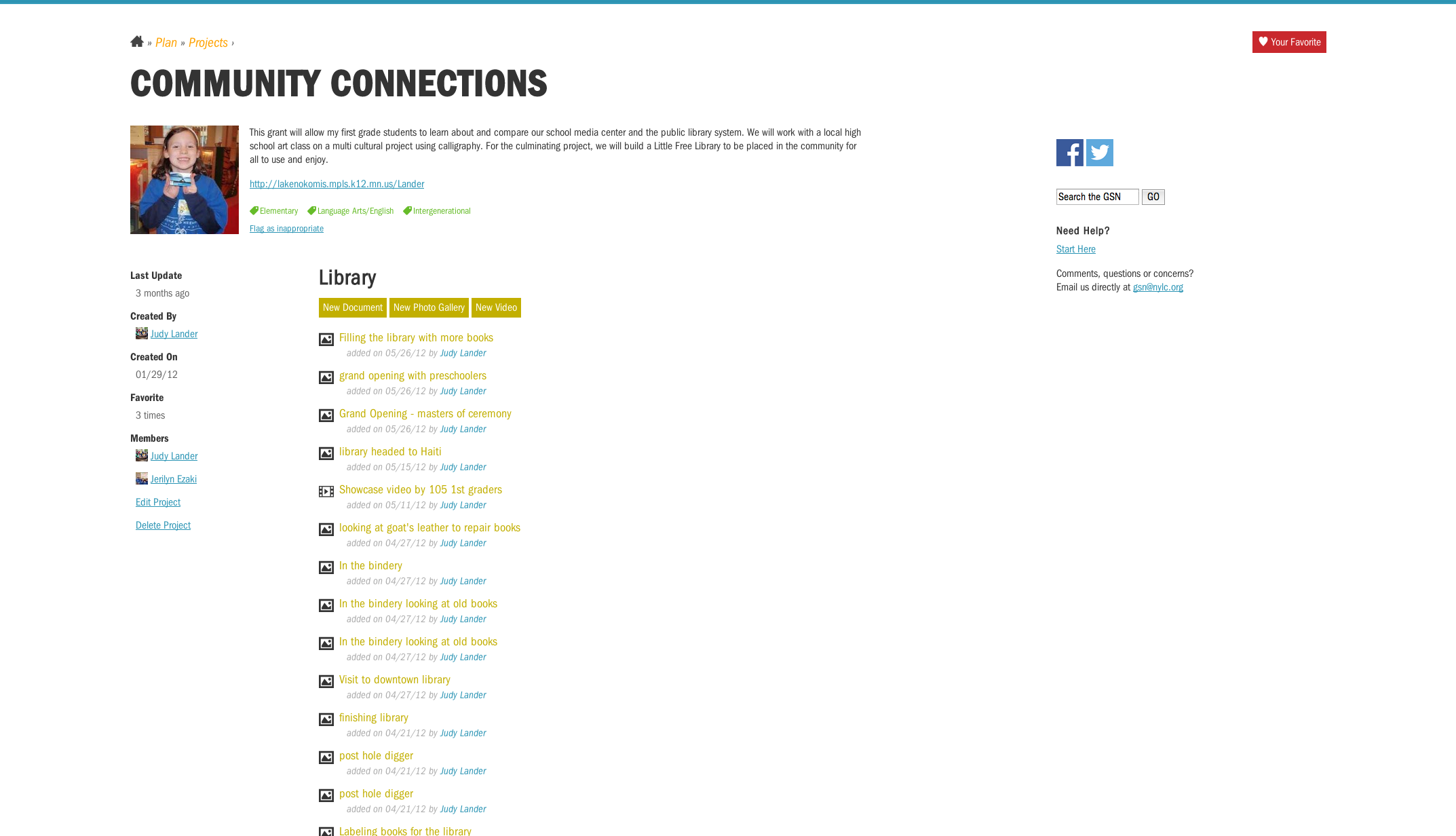
    Plan is a user-generated showcase of service-learning projects. We encourage members to upload their project at the inception of the idea vs. after they are all done and build the project as they go. This section will be transformed once the project-planning tool goes live because at this point there is not a lot of incentive for users to upload their projects. Maybe they want to share, see the community as a place to stay organized, or need to collaborate with a peer; but at this point we at NYLC are not supporting service-learning project planners as well as we could.

     www.gsn.nylc.org/plan

    Screen Shot 2014-04-29 at 7.08.52 AM

    Screen Shot 2014-04-29 at 7.09.59 AM

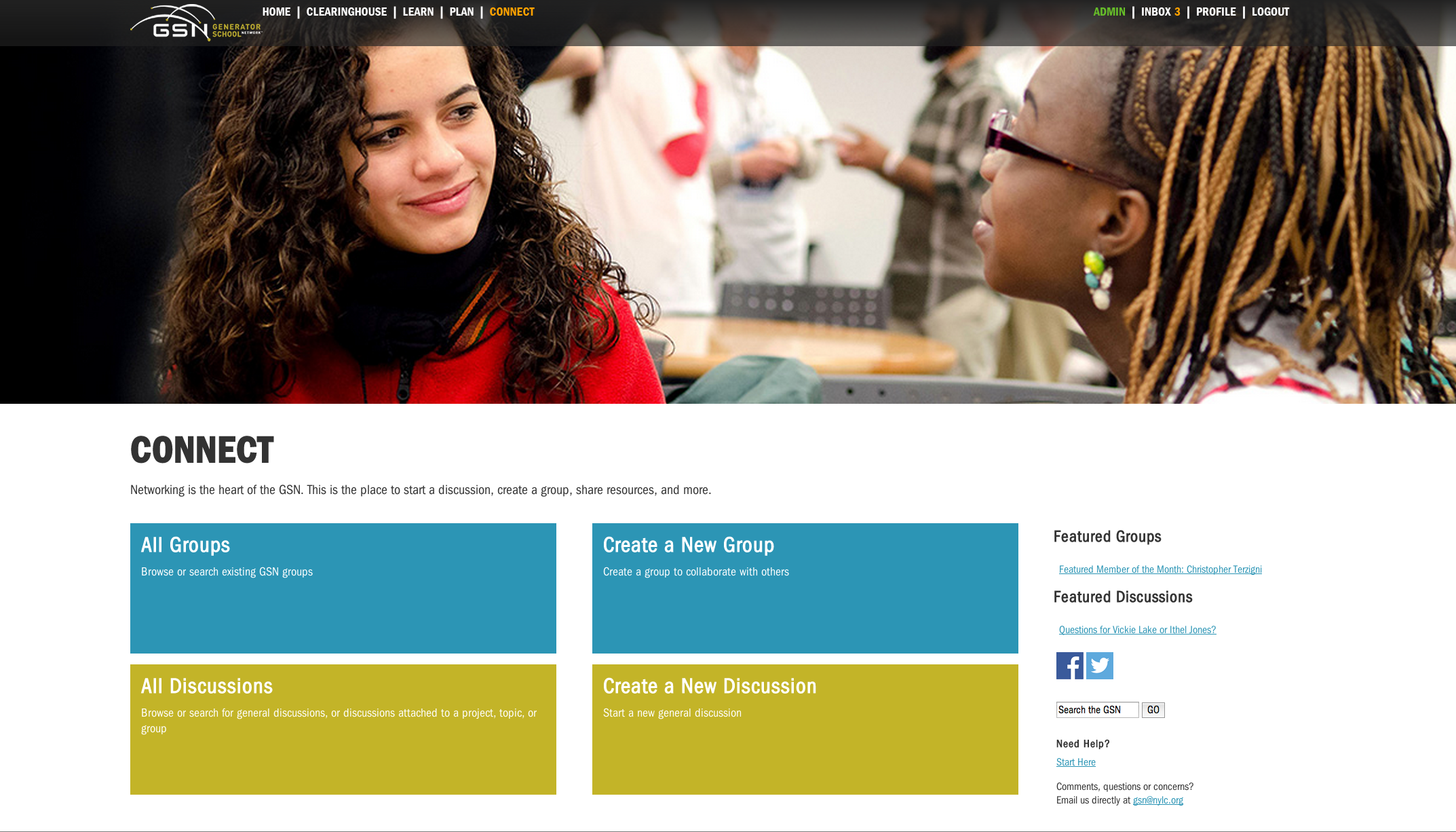
    Connect is where members can organize groups and discussions with peers that they work with locally or colleagues from across the field. It can also serve as a great organizer after an event to stay connected.

    www.gsn.nylc.org/connect 

    Screen Shot 2014-04-29 at 7.10.44 AM

    Now badges will be integrated across the platform and will encourage participation and contribution in all of the areas. The exact design is still to be decided but it will acknowledge behavior as simple as signing on to creating and administering a group.

  • Digital Learning Day 2014

    Digital Learning Day 2014

    Despite the technical issues we were having with our website, the show must go on. I was lucky to have an event like Digital Learning Day to take my mind off the server drama. While not directly connected to my project, the event taught me a lot and truly shifted my perspective on just how many people and organizations are invested in educational technology.

    At the heart of Digital Learning Day is quality teaching and learning from educators and students around the world. The day itself is really a celebration of the innovative lessons and projects that we know happen everyday in and out of classrooms. It is an opportunity to highlight some of the best tech-forward districts, organizations, and corporations from around the country. In order to make such a large international observance, the Alliance for Excellent Education calls upon the support of schools, nonprofits, and for-profits who believe that digital learning is a key component of a strong education.

    The National Youth Leadership Council shares in that belief and is honored to support Digital Learning Day as a core partner annually. As a core partner, we encourage our networks of educators and young people to participate in Digital Learning Day. To further support this initiative, partner organizations also share their quality resources for the digital learning toolkits that can be found on digitallearningday.org. One of the best benefits of being a partner for this initiative is attending the national event in-person. And one of the biggest benefits of being the “ED tech” specialist at work is getting to be that representative to attend the in-person celebration.

    The celebration started the night before at a beautiful reception held at the Alliance for Excellent Education’s office. It was nice to have a few hours to meet professionals who have mutual interests in educational technology, youth leadership, and access to quality teaching and learning tools. I left the celebration buzzing from all the wonderful conversations and new connections I had made. My excitement for the next day was growing by the second.

    photo-12

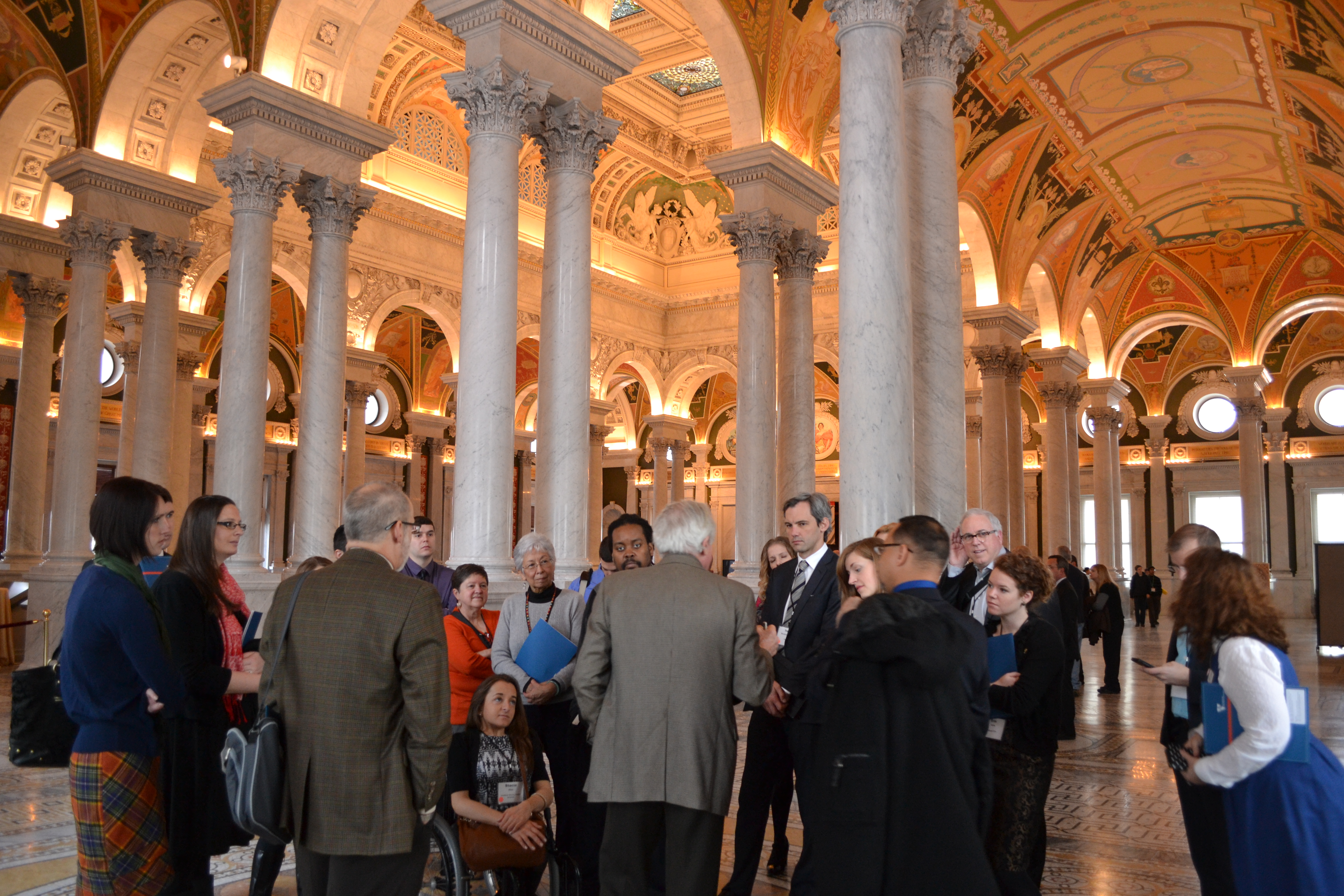
    Climbing up the steps to the Library of Congress in Washington D.C., butterflies started fluttering as I knew the day would be dynamic both in-person and online. A large group gathered to take a tour of the building that is covered in beautiful detail and symbolism. Libraries are the foundational setting for digital learning and media, which made the Library of Congress a perfect location for the celebration. And that location has also been the setting for many historical political decisions related to educational technology.

    DSC_0646

    DSC_0667

    After the tour we piled into the Coolidge Auditorium where we were welcomed by Dr. James Billington to the library. While the day of amazing examples of digital learning was just beginning, Tom Wheeler, the Chairman of the FCC reminded us that many educators do not have the access to the internet they need in their classroom. He shared that his goal was to have the first Erate updates completed before fall of 2014. Roberto Rodriguez, Special Assistant to the President for Education Policy, echoed Wheeler’s concern for internet access and added that this is really an issue of equity within education.

    DSC_0659

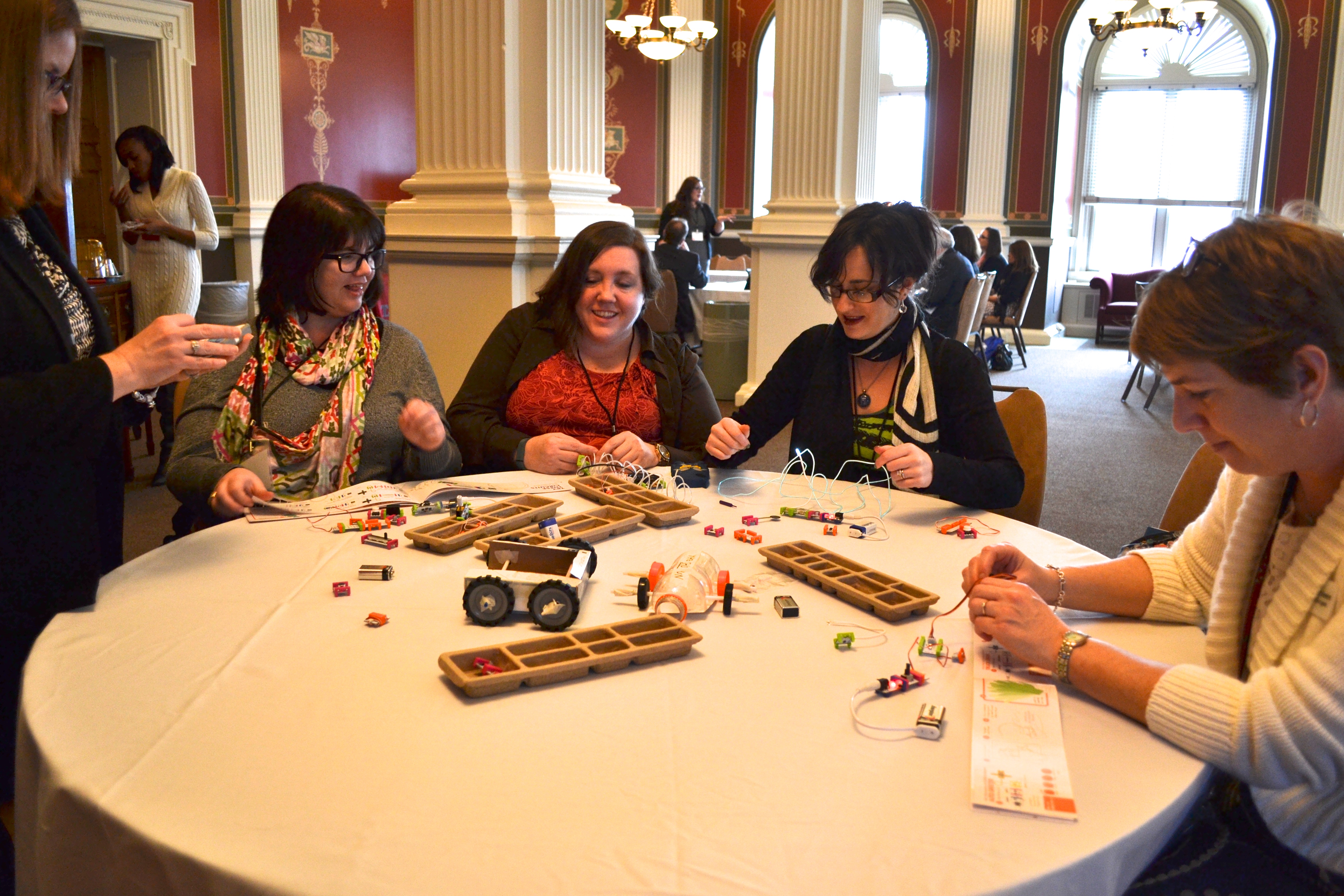
    The day became an exhibit of some of the best digital learning from around the country. Participants had the opportunity to talk with youth, educators, and administrators that were eager to share their replicable programs and projects. In the midst of the live celebration, many of us were also trying to keep up through Twitter and the Google Hangouts throughout the day. These digital and in-person opportunities to connect expanded personal learning networks and added new resources to our ED tech tool belts.

    DSC_0678 DSC_0681

    The live event culminated with a panel of district staff, state administrators, federal employees, and leaders from national organizations. The most dynamic panelist was a student, Amber Garrett from Talladega County, who shared the youth perspective from before and after the personalized learning initiative was implemented in her district. She cited that technology helped her develop 21st century skills and gave her opportunities to use those skills in the real world.

    DSC_0703

    Digital Learning Day 2014 taught me that while at the core of this issue is teaching and learning, everyone should have a vested interest and role in educational technology. If we don’t provide our young people with the best education possible our society, economy, and future is at risk. The use and access to technology and media, quality teaching methods, and excellent curriculum must be supported by students, educators, administrators, policy makers, IT professionals, community-based organizations, and corporate partners. The Alliance for Excellent Education does an amazing job organizing Digital Learning Day. NYLC is honored to be a core partner.

    If you missed the excitement from the day, check out #DLDay on Twitter or digitallearningday.org

    DSC_0670My view at lunch : )

    DSC_0652The young scholar on the right and the older scholar on the left represent life-long learning.

  • S.O.S.

    S.O.S.

    After a meeting with Angelica about my final project was feeling energized and ready to take action! Our web developer was working on some updates to the Ruby on Rails Platform, changing some settings on the site, and giving the GSN an updated look. Everything was falling into place to have a new and improved Generator School Network.

    Then…

    The GSN was mysteriously down due to server maintenance. Our web contractor submitted a help ticket to our server and received this message in return:

    We regret to inform you that the host machine that Cloud Server, gsn-demo, resides on cannot be recovered despite the very best efforts of our Engineering and Data Center Operations teams.  It has been determined that this server has experienced complete data loss.

    If you have a recent server image, your next step should be to build a new server from that image. Should you require the same IP, please contact support prior to deleting the impacted server from your account and we will assist you in sharing the IP to the new device.

    If you do not have a current server image, your next step will be to build a new server from a stock image and upload data from your local backup.

    Finally, you will need to delete the impacted server from your account to prevent any further billing associated with the device.

    Say What? Essentially the company that we pay every month to back up everything just stopped working. And this would not have been a problem except the server took a back up of a broken website and the site had not been externally backed up since SEPTEMBER! Which means we lost everything from September to the end of January that users and our staff had uploaded.

    At that point we had to decide to bring back the September version of the site or just wait two weeks and launch the new and improved GSN. We chose the latter because it meant things would move faster. We came up with some clever marketing in the meantime:

    february

    The GSN is experiencing flu-like symptoms which requires rest.

    Don’t worry — it isn’t contagious.

    Our cloud server crashed taking back-up copies with it.

    What this means to you: the GSN will be offline for about two weeks for rest and recovery. When it comes back on February 14 it will be better than ever with an updated look and all the resources of the National Service-Learning Clearinghouse.

    In the meantime, keep connected on Twitter, Facebook, and the K-12, HE, or CBO listservs. Visit nylc.org for service-learning resources, stories, and news, and check out our YouTube channel for recorded webinars. If you have any questions, please email us at gsn@nylc.org.

    Thank you for wishing the GSN a speedy recovery!

    Lana Peterson

    Deep breathes. Bad timing. I was trying to be grateful we didn’t loose everything. Needless to say this shifted my project a bit until I was able to get everything back to speed. I gave myself a crisis badge because… well I didn’t cry and crawl under my desk, and I really wanted to.

  • Introduction to CI5190

    Introduction to CI5190

    Time really does fly when you are having fun; it is hard to believe I am already at my final semester for my M.Ed. in Learning Technologies. This initial post is an introduction to my final project for CI5190; I will be using my blog to document my progress throughout the semester.

    Although I had some ideas for what I wanted my final project to be, in January the CI5190 students received an email from our new adviser Angelica Pazurek to give us further guidance for completing our final project. An excerpt from that email:

    Details About the M.Ed. Final Project

    The objective of the final capstone project is to showcase your skills and knowledge gained during the M.Ed.  This final project must be new work– it cannot be a repurposing of work that you have already done in other classes during your program.  However, it can be an extension of prior work; for example, you could add new things to a project you have been developing throughout your M.Ed. program.  The additions should be significant; that is, they must require a sufficient amount of effort and time investment from you befitting an M.Ed final capstone project.  If you choose to go this route, I will ask you to explain exactly what will be new or what you will add, extend, develop further, etc.  Or, you may have a whole new idea!

    As you are envisioning your M.Ed. project, you should strive to:

    1) Create something that solves a problem you care about.

    2) Create something that might be useful for others

    3) Use your LT knowledge

    The following excerpt is what I love about the Learning Technologies program at the University of Minnesota. Their aim is for you to be spending time on projects and assignments that are relative to your work and have actual application in the real world. This call to action makes the line between my work life and school life practically non-existent.

    Currently I am a Professional Development Manager at the National Youth Leadership Council (NYLC). Specifically I train adults and young people about leadership and service-learning both face-to-face and online. I manage our online platform, the Generator School Network (www.gsn.nylc.org) a community for youth and adults to learn, plan, and connect around service-learning. It is this role and my love for educational technology that drew me into the Learning Technologies program in the first place.

    Some Background

    The Generator School Network as an online community is almost five years old, my organization created it initially to stay connected to teachers that we work with across the country. The site has been built from the ground up but if we were starting this network now we would most likely use a pre-existing LMS. While the site has transformed throughout the years from it’s initial thinking one of the biggest changes was in July of 2012. The site was originally created for K-12 teachers to collaborate, but we had many non-formal educators and other educational professionals using the site as well.  Only catering to adults did not align with our mission so we opened the site to youth ages 13-18 and updated our security features.

    While young people were welcome to use the site it really wasn’t a community designed for young people. It needed a fresh look, more youth driven content, and some sort of incentive for participating. I asked one of our high school interns to give me feedback and she shared, “Participation is a big thing in making the GSN amazing. Youth are going to want an incentive in why they will participate [for instance] with @15, people got points when they participated and then they could use those points for other goodies, DoSomething.org has grants, and the 26 second campaign sends you a t-shirt just for liking them on Facebook”.

    She was right! But I would add it is not just youth who have a choice, adults have a choice as well. It was from that impetus that I began looking at user incentives for online participation not just to drawn them to our site but to get them to contribute and collaborate on our site. My search to find the holy grail of online incentives sent me tumbling down a rabbit hole of digital badges (which I will explain further in my blogs). This quest has pushed me to grow as a financial developer, an instructional designer, a project manager, evaluator, and technical developer all with the help of the LT program.

    The Project

    In the fall of 2013 NYLC secured funding through State Farm insurance to integrate digital badges and an interactive project-planning tool in the Generator School Network. Some initial thinking for this work happened in the fall in these classes (click the link to see the related projects)

    CI 5336- Planning for Multimedia Design and Development:

    CI5331 Introduction to Learning Technologies:

    CI5177 Practical Research- This was the basis for my research and what will be submitted to the IRB after further updates.

    The assignments in those courses allowed me to further research digital badges and create a draft plan for my project planning tool. To build on those projects I proposed my final M.Ed. project guide me through the first quarter of my website updates which includes:

    • Writing a web development RFP
    • Hiring a web developer
    • Conceptualizing and designing the GSN’s badge system
    • Conceptualizing and designing the GSN’s project planning tool
    • Submit my practical research paper to the institutional review board

    Read on to see how this project progresses throughout the semester!